
The Shadow Play of Starlight
One of the most powerful techniques for sniffing out alien atmospheres is called transit spectroscopy. Imagine a moth flying in front of a distant streetlight. From far away, you'd see the light dim slightly. Astronomers look for a similar effect when
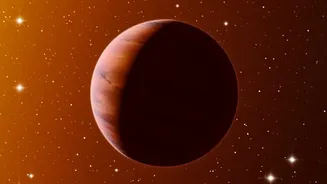
an exoplanet passes, or 'transits', in front of its host star. Powerful telescopes measure this tiny dip in brightness, which not only confirms the planet's existence and size but also provides a golden opportunity to study its air. As the starlight filters through the planet's atmosphere, the gases present absorb some of that light. This process leaves a faint, but detectable, imprint on the light that finally reaches Earth, carrying clues about the atmosphere's chemical makeup.
Reading the Barcode of an Atmosphere
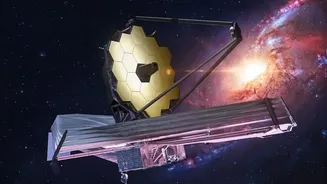
Every gas—water vapor, methane, carbon dioxide—absorbs light at very specific wavelengths, creating a unique chemical 'barcode'. When astronomers collect the light that has passed through an exoplanet's atmosphere, they use an instrument called a spectrograph to split that light into its full spectrum of colors, like a prism. By looking for dark lines where light is missing from the spectrum, they can match these patterns to the known barcodes of different molecules. Finding the specific signature of water (H2O) is a primary goal. The James Webb Space Telescope (JWST), with its incredible sensitivity to infrared light, is particularly adept at this, allowing scientists to identify these molecular fingerprints with unprecedented clarity.
The Challenge of a Direct Glimpse
Directly photographing an exoplanet is exceptionally difficult. The challenge is akin to trying to spot a firefly hovering next to a blindingly bright searchlight. The parent star's glare typically overwhelms the faint, reflected light of its planet. To overcome this, astronomers use instruments called coronagraphs, which are essentially sophisticated masks inside a telescope that block out the star's direct light, allowing the much fainter planet to become visible. This method works best for large, gas-giant planets that are in wide orbits around their stars. While challenging, direct imaging is a powerful tool because it allows astronomers to capture a planet's light directly and analyse its spectrum for atmospheric clues.
More Than Just Water
While finding water is a huge step, the ultimate goal is to find 'biosignatures'—any substance, element, or pattern that provides evidence of past or present life. This could be a combination of gases in an atmosphere that shouldn't exist together without a biological source constantly replenishing them. On Earth, for example, the simultaneous presence of abundant oxygen and methane is a strong indicator of life. Scientists are looking for similar chemical imbalances on exoplanets. A recent theory even suggests that a planet with significantly less carbon dioxide than its planetary neighbors could be a sign of a large ocean dissolving the gas from the atmosphere. Detecting these complex signatures requires incredibly precise measurements, but it's the key to moving from finding habitable worlds to finding inhabited ones.
A New Era of Discovery
The launch of the James Webb Space Telescope has revolutionized the search for habitable worlds. Scientists have already used its powerful instruments to detect water vapor in the atmospheres of several exoplanets, from hot gas giants to smaller, rocky worlds. In one fascinating case, JWST detected water's signature around a rocky planet so hot its surface should be molten, leading to a debate about whether the water is truly from the planet or a 'mirage' from cool spots on the star itself. These early discoveries showcase the telescope's extraordinary power and the complexity of the search. Each detection, and every puzzle, pushes our knowledge forward.