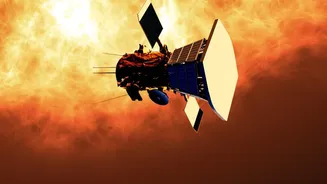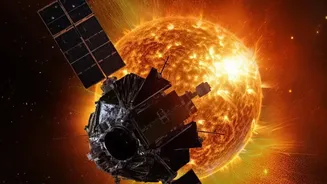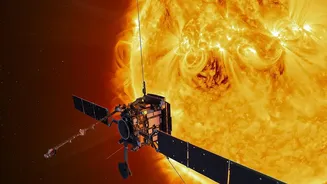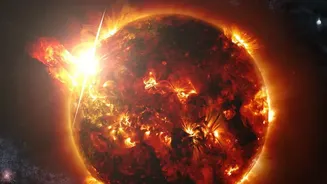



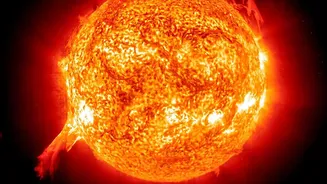
The Sun, our star, is a volatile giant, launching powerful bursts of material into space. For decades, seeing these eruptions at their very source has been a challenge, but a new partnership between two advanced space missions is changing that.
India’s Eye in the Sky
At the
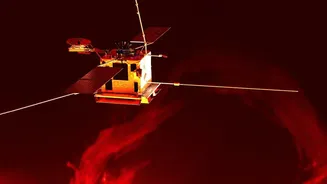
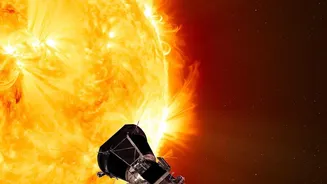
heart of this new observational power is India's own Aditya-L1, the nation's first dedicated solar observatory. Launched by ISRO in September 2023, it maintains a constant vigil over the Sun from a unique location called Lagrange Point 1 (L1), about 1.5 million kilometres from Earth. This vantage point allows it to watch the Sun without interruption, free from the eclipses or occultations that affect Earth-orbiting satellites. Aditya-L1 is equipped with a suite of instruments, but its crown jewel for this task is the Visible Emission Line Coronagraph, or VELC. Developed by the Indian Institute of Astrophysics, VELC is specifically designed to study the Sun's outer atmosphere, the corona, where violent events like Coronal Mass Ejections (CMEs) are born.
The Challenge of the Sun's Glare
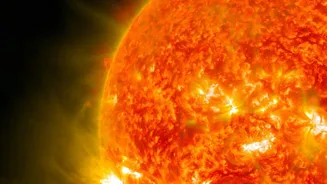
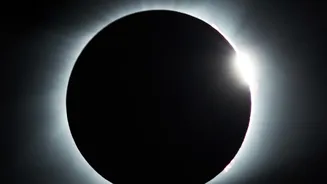
Studying the corona is incredibly difficult for one simple reason: the Sun is blindingly bright. The corona itself is millions of times fainter than the Sun's main disk, making it impossible to see under normal conditions. To get around this, scientists use instruments called coronagraphs, which use an 'occulter' disk to block the direct light from the Sun, creating an artificial eclipse. This reveals the faint corona around the edges. However, traditional single-spacecraft coronagraphs are limited by stray light diffracting around their internal occulters, which prevents them from seeing the crucial inner region of the corona, right where eruptions begin. Getting a clear view of this area is essential to understanding the physics that trigger space weather events.
A Partner in a Cosmic Dance
This is where the European Space Agency's (ESA) Proba-3 mission enters the picture. Launched in late 2024 by an ISRO PSLV rocket, Proba-3 is a revolutionary mission demonstrating precision formation flying. It consists of two satellites flying in perfect alignment, approximately 150 metres apart. One satellite acts as the occulter, casting a precise shadow onto the second satellite, which houses the coronagraph instrument, ASPIICS. This huge separation between the occulter and the telescope creates a 'giant coronagraph' in space, drastically reducing stray light and allowing ASPIICS to capture incredibly sharp images of the Sun's corona closer to the surface than ever before.
A Powerful Observational Pair
The true breakthrough comes from combining the capabilities of Aditya_L1's VELC and Proba_3's ASPIICS. While they are on separate missions, their fields of view can overlap, allowing them to observe the same event simultaneously. ASPIICS provides razor_sharp images, mapping the shape, dynamics, and mass of a CME as it erupts from the solar surface. At the same time, VELC provides a different kind of data through spectroscopy. It measures the properties of the superheated gas within the eruption, including its speed, density, and temperature. This dual approach allows scientists to cross_check their measurements, building a much more complete and confident picture of an eruption than either spacecraft could achieve alone.
Why Seeing the Source Matters
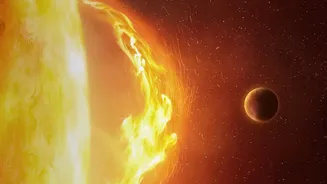
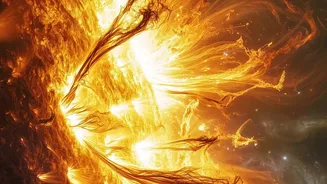
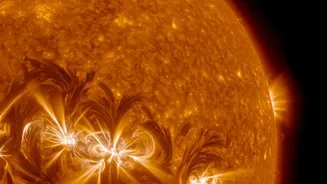
Observing CMEs right from their genesis is a holy grail for space weather forecasters. These eruptions can hurl billions of tonnes of magnetised plasma into space, and when aimed at Earth, they can disrupt power grids, damage satellites, and interfere with communication and navigation systems. By tracking the energy of these bursts from the very beginning, scientists can better understand the fundamental physics that drive them. A recent joint analysis of two CMEs in September 2025 demonstrated the power of this collaboration, revealing key differences in how the two eruptions distributed their energy. This level of detail is crucial for improving models that predict how a CME will evolve as it travels through space and what its potential impact on Earth might be.