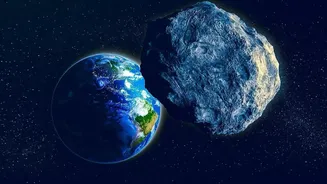




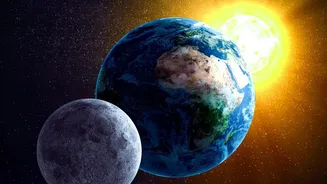
It sounds like science fiction, but Earth has a second moon — for now. A tiny asteroid, 2026 QQ8, was captured by our planet's gravity earlier this year. But this cosmic visitor is about to continue its journey, leaving our orbit in December.
What Is a 'Short-Term Moon'?
While we
all know and love our one permanent Moon, it’s not our planet's only natural satellite. Every so often, small asteroids get close enough to be temporarily captured by Earth's gravitational pull, earning them the informal name 'minimoons'. These objects are more accurately called temporary natural satellites. Unlike our large Moon, which has been our constant companion for billions of years, minimoons are transient guests. Their stays are brief, typically lasting a few months to a couple of years before they are flung back out into their own orbits around the Sun. These captures are more common than most people realize; it's just that the objects are usually very small and difficult to detect. Only a few have ever been confirmed by astronomers, including famous examples like 2006 RH120 and 2020 CD3.
Our Latest Visitor: 2026 QQ8
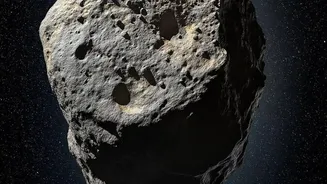
The latest minimoon, designated 2026 QQ8, was first spotted in August 2026. Scientists calculate that this small asteroid was pulled into Earth's orbit back in April. It is a tiny object, estimated to be only about six feet (or two meters) in diameter, roughly the size of a small car. Because of its small size, it took astronomers some time to confirm that it was a natural object and not a piece of old space junk, like a defunct satellite or rocket booster. The object was officially logged by the International Astronomical Union's Minor Planet Center, confirming its status as a temporary resident of our cosmic neighborhood. Don’t expect to see it with the naked eye; 2026 QQ8 is far too small and faint. It is currently orbiting at a distance about one-and-a-half times farther away than our main Moon.
A Brief and Wobbly Dance
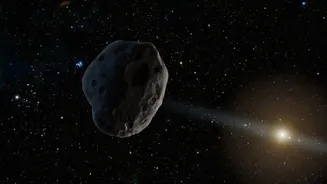
The orbit of a minimoon is nothing like the stable, nearly circular path of our large Moon. Instead, it’s a chaotic and complex dance. These tiny asteroids are caught in a gravitational tug-of-war between the Earth, the Sun, and our own Moon. This results in a looping, unpredictable trajectory. While captured by Earth, 2026 QQ8 continues to orbit the sun, taking about 359 days to complete its own journey around our star. Its temporary capture by Earth is just a brief detour on its much larger solar circuit. A typical minimoon might complete three orbits of Earth over a nine-month stay before escaping. The gravitational forces that pull these objects in are the same ones that eventually push them out.
Why Is It Leaving Now?
The very nature of being a minimoon is its temporary status. 2026 QQ8's departure is expected in December, though it might linger until early January 2027. Its escape is a predictable consequence of orbital mechanics. As it moves along its complex path, the gravitational influences of the Sun and the Moon will eventually give it the 'kick' it needs to break free from Earth's grasp. Once liberated, it will return to being just another near-Earth asteroid, orbiting the sun on a path that brings it close to our planet every decade or so. This is a harmless departure; even if its trajectory brought it toward our planet, an object this small would safely burn up in the atmosphere.
More Than Just a Passing Rock
While they may be small and fleeting, minimoons are of great scientific interest. They are some of the most accessible asteroids to reach from Earth, making them prime targets for study. Some scientists believe they could serve as stepping stones for future human exploration into the solar system, providing a nearby training ground for learning how to operate in deep space. Studying their composition offers clues about the building blocks of our solar system and the origins of life. Some theories even suggest that many minimoons could be fragments of our own Moon, blasted into space by ancient impacts. Analyzing these visitors can provide a unique chance to study lunar geology without the expense of a sample-return mission. Each captured object, like 2026 QQ8, gives us a rare opportunity to get an up-close look at the material that populates our corner of the cosmos.