




A World Without An Atmosphere
The single biggest reason for the footprints' incredible longevity is the Moon's lack of a significant atmosphere. Here on Earth, our planet is wrapped in a thick blanket of gases. This atmosphere creates weather: wind that blows sand and dust, and rain
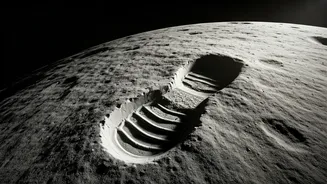
that washes surfaces clean. A footprint left in dry dust in an Indian desert might last a few hours or days before the wind scours it away. A footprint on a wet beach vanishes in seconds. The Moon has none of this. It exists in an almost perfect vacuum. There is no air, which means there is no wind to disturb the fine lunar dust, known as regolith. There is no water cycle, so there is no rain to wash the prints away. The moment the Apollo astronauts lifted their boots, they left impressions in a silent, static world where the normal forces of erosion simply do not exist. The prints are frozen in time, exactly as they were made.
The Great Stillness of the Lunar Surface
This lack of atmosphere creates an environment of profound stillness. The lunar regolith is a powdery layer of fine rock fragments and glass particles, pulverised by billions of years of meteorite impacts. It’s finer than sand and behaves almost like flour. When an astronaut stepped on it, the regolith compacted neatly under the boot, creating a sharp, clear impression.
Because there is no wind or water to move these fine particles around, the only way a footprint can be disturbed is by a direct physical impact. The regolith doesn't shift or settle on its own. The prints left by the 12 men who walked on the Moon are not just temporary marks; they are geological features, albeit very small ones. They sit undisturbed in a cosmic museum, waiting for a force to act upon them. And on the Moon, those forces are few and far between.
The Universe’s Slowest Eraser
So, if there's no wind or rain, are the footprints permanent? Not quite. They will last for millions of years, but not forever. The universe has its own, much slower, form of erosion: micrometeorite bombardment.
Space is not completely empty. It’s filled with tiny particles, many no larger than a grain of sand, travelling at tremendous speeds. Every day, the Moon is pelted by a constant shower of these micrometeorites. This process is often called 'space weathering' or 'gardening' because it slowly churns the top layer of the lunar soil over aeons. Each tiny impact kicks up a minuscule amount of dust, which settles back down. Over an immense timescale, this gentle, persistent rain of cosmic dust will gradually soften the edges of the footprints, fill them in, and eventually erase them completely. But this process is incredibly slow. Scientists at NASA estimate it could take anywhere from 10 to 100 million years for the prints to disappear.
A Pristine Record of History
The same conditions that preserve the footprints also preserve everything else. The Moon's surface is an astonishingly pristine record of the solar system's history. Craters from impacts that occurred billions of years ago are still visible, their features sharp and clear. The tracks left by the lunar rovers, the discarded equipment from the Apollo missions, and even the flags (though likely bleached white by solar radiation) are all sitting there, largely untouched.
This makes the Moon a treasure trove for scientists. By studying its surface, we can look back in time. The footprints serve as a powerful symbol of this. They are our first, fleeting marks on another world, and they will likely survive longer than the pyramids, longer than our cities, and perhaps longer than our species itself. They are a quiet monument to human exploration, preserved not by our own design, but by the fundamental, alien nature of the cosmos.