


The Coronal Heating Problem
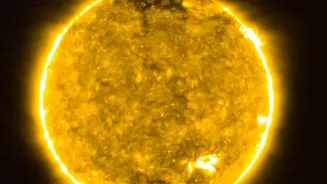
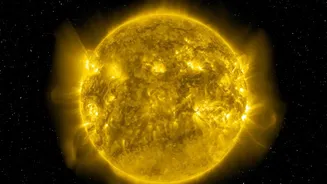
Imagine standing by a campfire, and it gets hotter the farther you walk away. That’s the puzzle of the sun's corona. The visible surface of the sun, the photosphere, is a scorching 5,500 degrees Celsius. Its outer atmosphere, the corona, inexplicably
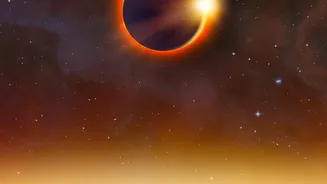
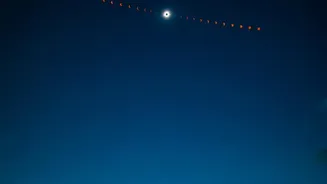
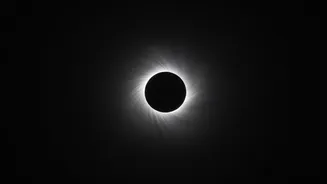
skyrockets to over a million degrees. For decades, scientists have theorized that the sun's complex magnetic field is responsible, but seeing it in action is incredibly difficult. The corona is a million times dimmer than the sun's surface, making it invisible except during the fleeting moments of a total solar eclipse, when the moon acts as a natural shield. This makes every totality a critical opportunity for science.
A Coordinated Scientific Assault
The 2026 eclipse, visible over parts of Greenland, Iceland, and Spain, was targeted by a multi-pronged scientific effort. NASA deployed its WB-57 high-altitude research aircraft, flying at 50,000 feet to chase the moon's shadow. By flying along the eclipse path, the jet extended the observation time from just over two minutes on the ground to nearly three minutes, capturing at least 20 high-resolution images per second. These images, taken in different wavelengths of light, were designed to map the corona's structure and temperature in unprecedented detail. Meanwhile, teams on the ground and with high-altitude balloons measured how Earth's own atmosphere responded to the sudden loss of sunlight.
Early Hints from the Data
While it will take months or even years to fully analyze the data, preliminary findings are already generating excitement. Scientists are poring over images of massive prominences—giant loops of plasma erupting from the sun's edge—which were captured in stunning detail. Understanding these eruptions is key to predicting space weather, which can disrupt satellites and power grids on Earth. This eclipse was also unique because it occurred as Solar Cycle 25 is declining from its 2024 peak. This transitional phase was expected to create a complex, hybrid corona—neither the chaotic spikes of a solar maximum nor the calm symmetry of a minimum—giving researchers a rare look at the sun's changing magnetic field.
A View from Space and Earth
The eclipse observations are even more powerful when combined with data from spacecraft already studying the sun. The ESA's Solar Orbiter and Proba-3 missions ran special observation campaigns to coincide with the event. Proba-3, a unique mission that uses two satellites flying in precise formation to create its own artificial eclipses, provided a prediction of the corona's appearance by observing the sun two weeks prior. By comparing the ground-based eclipse views with the continuous observations from space, scientists can build a more complete, three-dimensional model of the corona. Recent findings from Proba-3 have already surprised researchers, showing that the 'slow' solar wind is moving three to four times faster near the sun than previously thought.