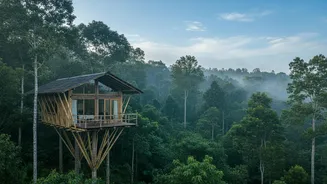







The Treetop Allure of Wayanad
There's a timeless magic to a treehouse. It speaks to a desire for adventure and a closer connection to the natural world. In Wayanad, a region famed for its mist-clad mountains, lush rainforests, and sprawling spice plantations, this concept is taken
to a new level. The landscape, a rich tapestry of dense greenery and undulating hills, provides the perfect canvas for these elevated escapes. Unlike conventional resorts, treehouses here are not about dominating the landscape but becoming a part of it. They offer a perspective that is both literally and figuratively above the everyday, allowing guests to immerse themselves in the serene environment from a unique vantage point.
Bamboo: Nature’s Sustainable Super-Material
The secret to the sustainability of these structures lies in their primary material: bamboo. Often mistaken for a tree, bamboo is actually a type of grass, and it's one of the fastest-growing plants on Earth. Some species can grow over a metre in a single day, and a culm can be ready for harvest in just three to six years, compared to the decades required for traditional timber. This rapid renewability makes it an exceptionally eco-friendly resource. Furthermore, bamboo is a champion of carbon sequestration, absorbing significantly more carbon dioxide than an equivalent stand of trees. When harvested, the root system remains intact, preventing soil erosion and allowing for natural regeneration. Its strength and flexibility are also remarkable, making it resilient in various climates and even in seismically active zones.
Crafting an Eco-Friendly Haven
Building a treehouse in Wayanad is an exercise in mindful construction. Many resorts prioritize the use of local and natural materials beyond just bamboo, incorporating coir, hay straws, and wood from sustainable sources. Often, these structures are built by local artisans and tribal communities, blending traditional knowledge with modern engineering to create accommodations that are both safe and authentic. The design philosophy is one of minimal impact. Instead of clearing forest, treehouses are built to coexist with their surroundings, often without using a single nail in the host tree. This quiet approach to sustainability extends to operations, with many properties utilizing solar power and managing waste responsibly to keep their carbon footprint low. The result is a stay that feels deeply connected to the local ecosystem and culture.
More Than Just a Room with a View
An escape to a Wayanad treehouse is about the experience, not just the accommodation. It's an opportunity for what is known as 'forest bathing'—immersing oneself in nature to reduce stress and restore mental clarity. Waking up surrounded by the constant, gentle rhythm of the forest has a profound effect that a scheduled nature walk cannot replicate. Days can be spent trekking through rainforests, visiting nearby waterfalls, practicing yoga, or learning new skills like local cooking. Many resorts are located within or near coffee and spice plantations, offering guests a fragrant, sensory journey into the region's agricultural heritage. It's a form of tourism that encourages connection—with nature, with the local community, and with oneself.
The New Eco-Luxury
The term 'eco-friendly' doesn't have to mean sacrificing comfort. While some treehouses offer a rustic, back-to-basics experience, many provide modern luxuries. You can find treehouses with well-appointed interiors, attached bathrooms with hot water, and private balconies perfect for birdwatching or stargazing. Some resorts feature amenities like swimming pools, Ayurvedic spas, and multi-cuisine restaurants serving dishes made from organic, locally-sourced produce. This blend of natural immersion and modern comfort makes the experience accessible to a wide range of travellers, from adventurous couples on their honeymoon to families seeking a memorable holiday. It’s a quiet, responsible luxury that feels more genuine than loud promises.