
What Are These Cosmic Tornados?
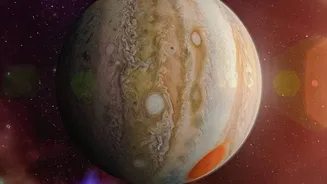
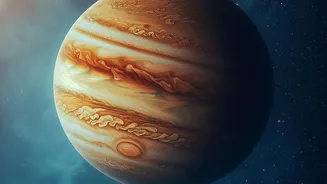
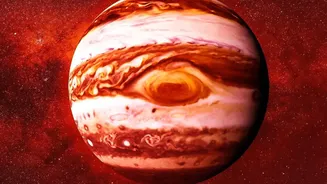
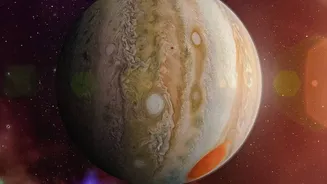
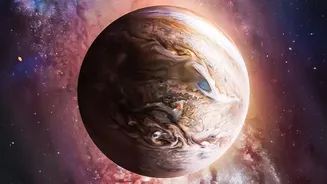
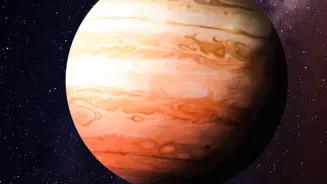
While the term 'cosmic tornados' paints a dramatic picture, these features are actually gigantic storms known as anticyclones. The most famous of these is the Great Red Spot, a high-pressure vortex that has been raging for at least 190 years. Unlike hurricanes
on Earth, which are low-pressure systems and dissipate over land, Jupiter's storms are vast, long-lasting, and powerful enough to swallow planets. The Great Red Spot was once wide enough to fit three Earths side-by-side, but has been steadily contracting for over a century. These storms are confined by powerful jet streams blowing in opposite directions, which constantly churn them like a cosmic spinning top, preventing them from breaking apart and allowing them to rage for centuries.
A New View From Above
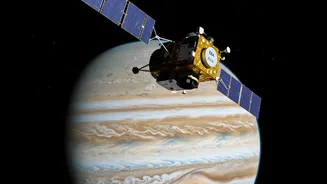
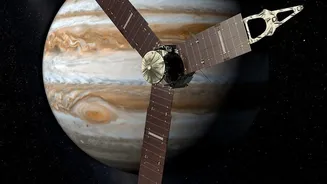
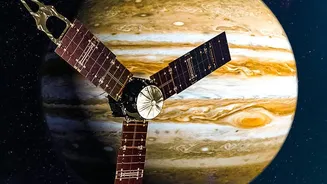
Our understanding of these shrinking giants is being transformed by a combination of powerful observatories. NASA's Juno spacecraft, which has been orbiting Jupiter since 2016, provides the most detailed views ever captured. During its close flybys, Juno skims just thousands of kilometres above the planet's cloud tops, using instruments like its microwave radiometer to peer deep beneath the surface. This has allowed scientists to create the first 3D maps of the storms, revealing they have roots that extend hundreds of kilometres into the gas giant's atmosphere. These observations are often combined with long-range data from the Hubble Space Telescope, which has been tracking the storms' size and colour for decades, creating a timeline of their evolution. Citizen scientists also play a crucial role, processing raw image data from JunoCam to create stunning colour-enhanced visuals and helping to categorize new vortices.
The Incredible Shrinking Storms
The data is clear: Jupiter's most iconic storm is getting smaller. Historical observations from the late 1800s measured the Great Red Spot at over 40,000 kilometres across. By the time the Voyager probes flew by in 1979, it had shrunk to about 23,000 kilometres. Recent Hubble observations confirm it is now just over 16,000 kilometres in diameter, barely wide enough to fit one Earth. The rate of shrinkage even appears to have accelerated since 2012, with the storm losing hundreds of kilometres of its width each year and changing from a distinct oval to a more circular shape. But it's not just shrinking in width. As the storm contracts, some evidence suggests it is also growing taller, stretching higher into the planet's upper atmosphere. This complex transformation has scientists racing to understand the forces at play.
Why This Matters for Planetary Science
The shrinking of the Great Red Spot poses a major puzzle for planetary scientists. What is causing this centuries-old storm to lose energy and contract? One hypothesis is that changes in the jet streams that contain the storm are a factor. Another theory suggests that the storm's 'diet' is changing. For centuries, the Great Red Spot has maintained its energy partly by absorbing smaller storms that drift into its path. A recent study using 3D simulations showed that a reduced frequency of these smaller storms being 'fed' to the larger vortex could be causing it to shrink. While the storm's vortex remains powerful, its visible cloud layer is clearly changing. Understanding whether the Great Red Spot will eventually disappear, like a previous 'Permanent Spot' observed in the 1600s, or stabilize at a smaller size, is a key question that will reveal fundamental truths about how atmospheres on giant planets work.