

The Rocket's Size Problem
One of the biggest hurdles in designing missions to other worlds is a simple matter of geometry. Every spacecraft must fit inside a rocket’s payload fairing—the nose cone that protects it during launch. This sets a hard limit on the size of any equipment
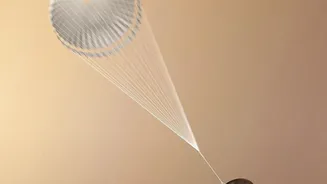
you can send, including the crucial heat shield, or aeroshell, needed for landing. For planets with thin atmospheres like Mars, this is a major problem. A small shield doesn’t create enough drag to effectively slow a heavy spacecraft, limiting the size of landers and rovers we can send. This constraint has been a significant bottleneck, especially for ambitious goals like sending human habitats or large-scale scientific laboratories to the Martian surface.
An Inflatable Solution
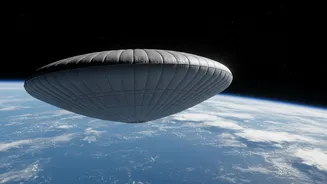
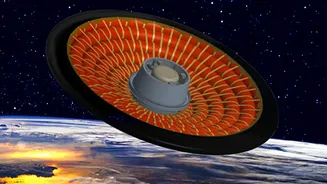
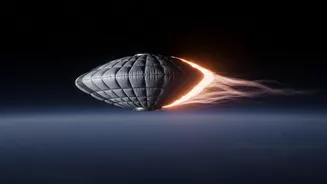
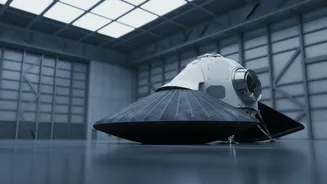
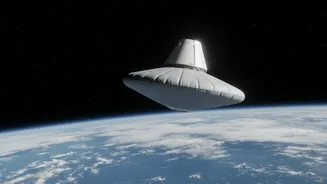
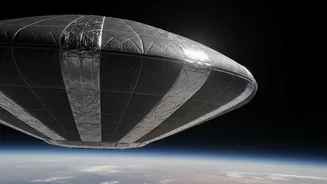
The answer, developed by NASA, is the Hypersonic Inflatable Aerodynamic Decelerator (HIAD). Instead of a solid, heavy shield, the HIAD is a deployable structure that can be packed into a small volume for launch. Just before atmospheric entry, it inflates like a high-tech life raft, expanding to a diameter much larger than any rigid shield could be. This massive surface area acts like a powerful air brake, grabbing onto the thin upper atmosphere to start slowing the vehicle down much sooner and more gently. The structure itself is made of tough, woven synthetic polymer rings, while the side facing the intense heat of re-entry is covered with a flexible thermal protection system made of advanced ceramic fibres that can withstand temperatures of around 1,600 degrees Celsius.
A Successful Trial by Fire
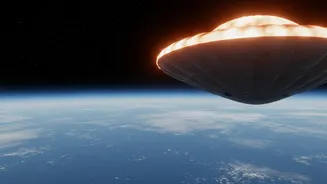
This technology is not just theoretical. In November 2022, NASA conducted a landmark test called the Low-Earth Orbit Flight Test of an Inflatable Decelerator, or LOFTID. A six-metre-wide inflatable shield was launched into space and then sent plummeting back to Earth at more than 18,000 miles per hour. It successfully endured the blistering heat and extreme forces of re-entry, inflated perfectly, and slowed the vehicle down before splashing safely into the Pacific Ocean, where it was recovered. The test was declared a resounding success, proving that the inflatable design could survive real-world conditions and protect its payload. This successful demonstration effectively graduated the technology from an experimental concept to a flight-proven system ready for future missions.
Unlocking the Next Frontier
The success of LOFTID opens up a new era of planetary exploration. The primary application is for Mars, where the technology will allow NASA and other agencies to land payloads much heavier than what is currently possible, a critical step for future human missions. But the potential goes further. Inflatable shields could be used for missions to Venus or Saturn’s moon Titan, both of which have atmospheres. The technology also has applications closer to home. Commercial companies are exploring its use for safely returning manufactured goods from space stations in low-Earth orbit. Furthermore, United Launch Alliance is investigating HIAD technology as a way to recover and reuse the valuable main engines from its Vulcan rockets, a key step in reducing the cost of access to space.