

A Landmark Discovery in Deep Space
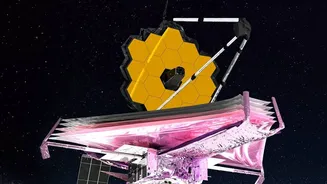
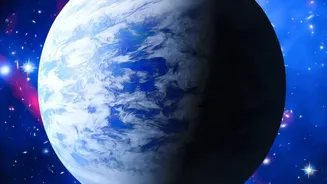
The James Webb Space Telescope has successfully identified the chemical signature of water vapour in the atmosphere of multiple planets orbiting distant stars. This isn't just a hint of water; it's a detailed atmospheric profile made possible by the telescope's
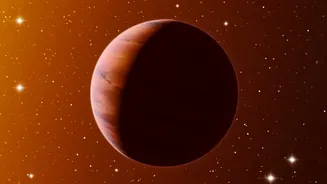
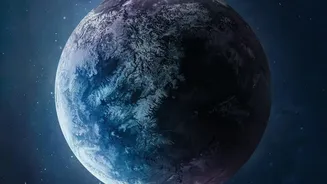
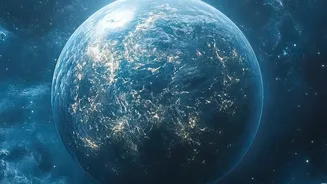
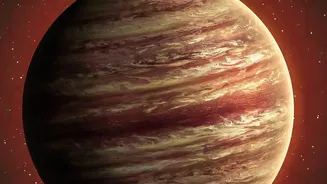
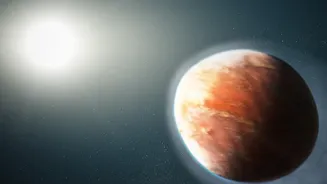
unprecedented sensitivity. These findings, often focusing on planets many light-years away, represent a monumental step forward in our quest to understand worlds beyond our own solar system. For example, observations have targeted a range of planets, from hot gas giants like WASP-18 b to smaller 'sub-Neptunes'. While some of these worlds are far too hot to support life as we know it, detecting water in such diverse environments demonstrates JWST's remarkable capability.
How to Read an Alien Atmosphere
So, how do scientists 'see' water from trillions of kilometres away? The technique is called transmission spectroscopy. When an exoplanet passes in front of its host star from our perspective, a tiny fraction of the starlight filters through the planet's atmosphere. Different molecules in that atmosphere absorb light at very specific wavelengths. The JWST's powerful instruments, like its Near-Infrared Spectrograph, capture this filtered light and spread it out into a spectrum—a kind of barcode of light. The dark lines or dips in this spectrum are absorption features that act as the chemical fingerprints of the molecules present. A specific pattern of dips tells scientists, with high confidence, that water vapour is present.
Why Finding Water Vapour Is a Game-Changer
On Earth, life exists virtually everywhere there is water. This makes the discovery of water elsewhere in the galaxy incredibly profound. While finding water vapour doesn't automatically mean a planet is habitable or has liquid oceans, it is a critical prerequisite. Scientists are looking for planets in the 'habitable zone'—the orbital distance from a star where conditions could be just right for liquid water to exist on a planet's surface. Detecting water vapour confirms that a key ingredient for life is present in the planet's atmospheric system. In some cases, like the planet PDS 70, water vapour was detected in the inner disk where rocky, Earth-like planets are thought to be forming, suggesting that the building blocks for habitable worlds are available from the very beginning.
The Power of the Webb Telescope
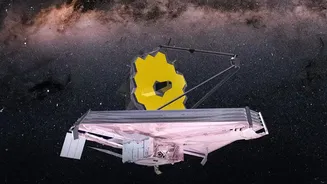
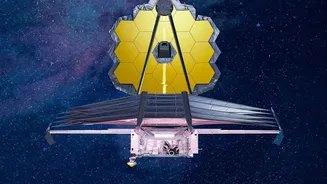
Before the James Webb Space Telescope, our views of exoplanet atmospheres were often limited. Telescopes like Hubble made groundbreaking initial detections, but many attempts resulted in flat, featureless spectra, often obscured by haze or clouds. The JWST, operating in the infrared part of the spectrum and with a much larger mirror, can peer through this haze and capture much finer details. Its sensitivity allows it to detect even subtle water signatures on a wider variety of planets, including smaller rocky worlds that were previously difficult to study. This technological leap has transformed the field, moving it from simply detecting planets to beginning the detailed characterization of their environments.
What Comes Next in the Search for Habitable Worlds?
This discovery is not an endpoint but a thrilling new beginning. Each detection of water vapour provides a crucial data point, helping scientists build a catalogue of worlds with potentially life-sustaining ingredients. The next step is to use the JWST to search for a whole suite of atmospheric gases. Scientists will be looking for biosignatures—combinations of gases like oxygen, methane, and carbon dioxide that, when found together, could strongly indicate the presence of biological processes. While many of the planets found with water so far are inhospitable 'steam worlds' or scorching gas giants, these findings refine the search and bring us one step closer to answering one of humanity’s oldest questions: Are we alone in the universe?