








The Calorie Burn Question
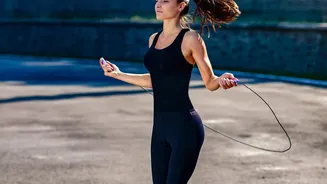
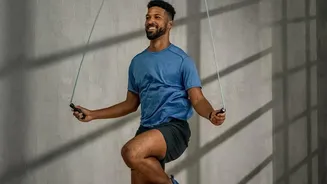
When it comes to burning calories efficiently, skipping, or jumping rope, has a clear advantage. It is a high-intensity activity that elevates your heart rate quickly. Studies and fitness data show that skipping can burn roughly two to three times more
calories per minute than brisk walking. For example, a 10-minute session of jumping rope can be equivalent in energy expenditure to a 30-minute brisk walk. The Metabolic Equivalent of Task (MET) value, a measure of energy expenditure, for fast-paced skipping is around 12.3, while a very brisk walk is closer to 5.0. However, this doesn't tell the whole story. While skipping is more efficient, walking is an activity that most people can sustain for much longer periods. A 45-minute walk might end up burning a similar total number of calories as a 10-minute skip, making consistency the most important factor for weight management.
Impact on Your Joints and Bones
A common assumption is that the high-impact nature of skipping is harsh on the knees, but research suggests the opposite may be true when compared to running, a similar high-impact exercise. Skipping, when done with proper form (staying on the balls of the feet, small jumps), can produce less force on the knee joints than running does. Walking, by its nature, is a low-impact exercise because one foot is always on the ground, making it an excellent choice for beginners, individuals with joint issues, or those recovering from injury. For bone health, the conversation shifts slightly. Weight-bearing exercises are crucial for building and maintaining bone density. The higher impact of skipping provides a stronger stimulus for bone growth compared to walking. While walking helps prevent bone loss, activities like jumping rope can actively help build bone mass.
Muscles Worked and Skills Gained
Walking is a fantastic lower-body workout, primarily engaging the calves, hamstrings, quadriceps, and glutes. Swinging your arms actively can also provide a mild upper-body and core workout. Skipping offers a more comprehensive, full-body workout. It intensely works the calves, but also engages the core for stability, and the shoulders, back, and arms for turning the rope. Beyond muscle strength, skipping is a superior activity for developing coordination, agility, balance, and rhythm. The need to time your jumps with the swing of the rope forces your brain and body to work together, a skill that benefits overall athleticism and can make exercise feel more engaging.
Accessibility and Practicality
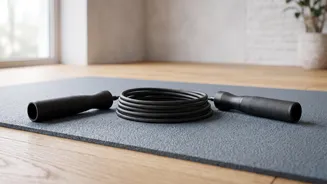
Walking is arguably the most accessible form of exercise on the planet. It requires no special equipment beyond a comfortable pair of shoes, can be done almost anywhere, and is easy to integrate into a daily routine, such as by walking during a lunch break or taking the stairs. It's free and has a very low barrier to entry. Skipping is also highly accessible but comes with a few more requirements. You need a jump rope, which is an inexpensive piece of equipment, and enough space to swing it without hitting anything. There is also a small learning curve to develop the rhythm and coordination to skip continuously, which can be frustrating for absolute beginners.