



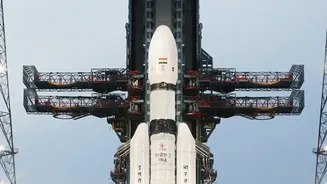
Meet Pushpak, India’s Space Shuttle
At the heart of this revolution is ISRO’s Reusable Launch Vehicle (RLV), a winged craft affectionately named ‘Pushpak’. Unlike traditional rockets that are discarded after a single use, Pushpak is designed to fly into space, deploy its payload, and return
to Earth, landing on a runway much like an airplane. This technology is one of the most challenging endeavours undertaken by ISRO, combining the complexities of both a launch vehicle and an aircraft. The goal is to create a Two-Stage-To-Orbit (TSTO) vehicle where the most expensive component—the winged first stage containing the crucial electronics and engines—can be recovered and reused, drastically cutting the cost and effort between missions. This ambitious project positions India in an elite club of nations developing next-generation space transportation systems.
Acing the Landing Tests
The journey towards reusability is marked by critical milestones, and ISRO has been methodically clearing them. The recent series of Landing Experiments (LEX) conducted at the Aeronautical Test Range in Chitradurga, Karnataka, has been a resounding success. In these tests, a prototype of Pushpak is lifted to an altitude of 4.5 km by an Air Force Chinook helicopter and then released. From there, the vehicle must autonomously navigate its way to a runway, manage its descent, and execute a perfect horizontal landing at speeds exceeding 320 km/h. The latest tests have successfully demonstrated this capability even under more challenging conditions, such as severe crosswinds and being released further away from the runway, proving the robustness of its onboard guidance and control systems. Crucially, ISRO has also reused the same winged body from a previous test, directly demonstrating the vehicle's reusability.
The 80% Cost Reduction Dream
The primary driver behind the RLV program is economics. Imagine if every time you took a flight, the airline had to throw away the entire airplane. That is how traditional space launches have operated, making them incredibly expensive. By making the most costly parts of the rocket reusable, ISRO aims to dramatically lower the price of sending satellites into orbit. Officials estimate that this technology could reduce launch costs by a staggering 80 percent. The target is to bring down the cost of delivering one kilogram of payload to Low Earth Orbit from the current price of around $20,000 to as low as $4,000. This cost reduction is not just a budgetary gain; it makes space more accessible for a wider range of scientific, commercial, and strategic applications.
India’s Competitive Edge in Space
Mastering reusable launch technology is about more than just saving money; it’s about securing India’s future in the competitive global space market. As the world increasingly relies on satellites for communication, data, and navigation, the demand for affordable launch services is skyrocketing. With Pushpak, ISRO is developing an indigenous solution that can compete with international players like SpaceX. This capability ensures strategic autonomy, meaning India will not have to depend on other nations for launching its critical satellites. Furthermore, it opens the door for ISRO to capture a larger share of the commercial launch market, which is projected to be a multi-billion dollar industry. This technology is a key enabler for India’s ambitious future plans, including the 'Bharatiya Antariksha Station' (India's space station) and long-term human spaceflight missions.
What Lies Ahead for Pushpak?
The successful landing experiments are a foundational step, but the journey is far from over. Having proven the vehicle's autonomous landing capability, ISRO is now shifting its focus to the next major phase: the Orbital Re-entry Experiment (ORE). This will involve launching a scaled-up version of Pushpak into orbit on a conventional rocket. After circling the Earth, the vehicle will have to survive the intense heat of re-entry and perform an autonomous landing on a runway. The ORE will be the ultimate test of the vehicle's design and thermal protection systems, bridging the gap between the current atmospheric tests and a fully operational reusable launch system. Success in this phase will pave the way for a future where Indian rockets launch, return, and fly again, making access to space cheaper and more routine than ever before.