



A Hat-Trick of Perfect Landings
ISRO has achieved a hat-trick of successes with its Reusable Launch Vehicle (RLV) program. The most recent test, part of the Landing Experiment (LEX) series, saw the winged vehicle 'Pushpak' dropped from an Indian Air Force Chinook helicopter at an altitude
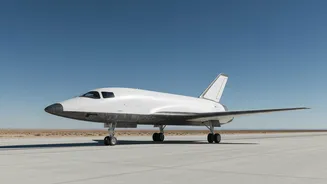
of 4.5 km. From there, the vehicle autonomously navigated its way to a runway at the Aeronautical Test Range in Chitradurga, Karnataka, performing a perfect, high-speed horizontal landing. This final test was conducted under more challenging conditions than previous ones, proving the robustness of the vehicle's autonomous guidance and control systems. By successfully simulating the high-speed, unmanned landing conditions of a vehicle returning from orbit, ISRO has validated some of the most critical technologies needed for a fully reusable launch system.
Why Reusability is the Holy Grail
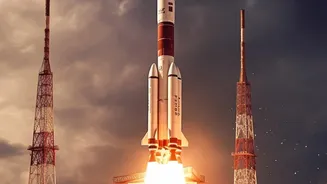
Think of it like the difference between a disposable paper cup and a ceramic mug. Traditional rockets, like the PSLV and GSLV, are expendable; their expensive, high-tech stages are discarded after a single use. Reusable launch vehicles, on the other hand, are designed to function like an aircraft, capable of being launched into space and then returning to Earth to be refurbished and flown again. The primary goal is to drastically reduce the cost of accessing space. By recovering and reusing the most expensive parts of the rocket, ISRO aims to slash the cost of delivering a payload to low Earth orbit by as much as 80 percent, from an estimated $20,000 per kg to around $4,000 per kg.
Meet 'Pushpak': India's Space Shuttle
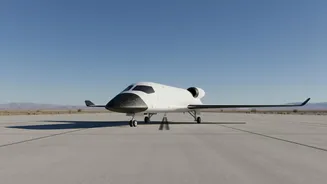
The star of the show is the RLV-TD (Reusable Launch Vehicle - Technology Demonstrator), affectionately named 'Pushpak' after the mythical flying palace. It’s a winged body vehicle that looks like a miniature space shuttle. Its design combines the complexity of a rocket and an aircraft. During the recent LEX tests, Pushpak demonstrated its advanced autonomous capabilities, using a suite of sensors and a sophisticated guidance algorithm to correct its course and execute a precise landing at over 320 km/h. The vehicle even reused the same winged body and flight systems from a previous test, proving the design's robustness and potential for repeated use.
The Road Ahead: From Landing to Orbit
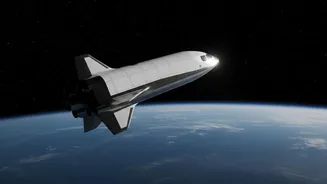
These successful landing tests are a crucial stepping stone, but the journey is far from over. The LEX series focused on the final, atmospheric landing phase. The next major challenge is the Orbital Re-entry Experiment (ORE). In this future mission, ISRO plans to launch a scaled-up version of Pushpak into a 400 km orbit on a conventional rocket. The vehicle will then stay in orbit before performing a controlled re-entry through Earth's atmosphere—surviving extreme temperatures—and finally landing autonomously on a runway, just like in the LEX tests. This will be the ultimate validation of the technology before an operational, two-stage-to-orbit reusable launch vehicle can be fully realised.
A New Era for India in Space
Mastering reusable launch technology will be a game-changer for India. Cheaper launches mean more satellites can be placed in orbit, boosting everything from telecommunications and navigation services to weather forecasting and scientific research. It will also make India a more formidable player in the multi-billion dollar global launch market, offering a cost-effective, homegrown alternative. While ISRO has stated its focus is on national needs rather than direct competition with private players like SpaceX, the development of Pushpak and a future Next Generation Launch Vehicle (NGLV) signals India's ambition to secure a self-reliant and sustainable future in space.