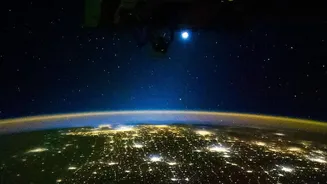







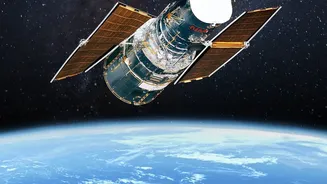
For millennia, the night sky has been a source of wonder and scientific discovery. But a new technological gold rush to place data centers in orbit threatens to fill our view with thousands of artificial stars, raising profound questions about progress.
Why Put Data Centers in Space?
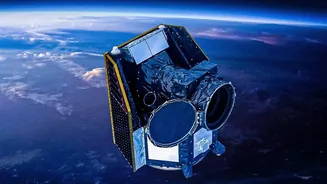
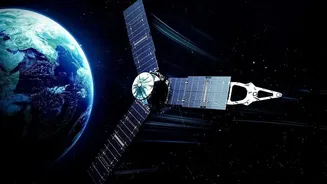
The explosive growth of artificial intelligence is creating an insatiable demand for energy and land. Terrestrial data centers consume enormous amounts of power for processing and cooling, with a single large facility sometimes using as much electricity as a small city. In response, a new sector is emerging: orbital computing. Companies like SpaceX, Google, Starcloud, and Orbital Inc. are planning to deploy vast constellations of satellites that are, in effect, floating data centers. The logic is compelling: in orbit, there is uninterrupted access to solar power and the vacuum of space provides a free, highly effective cooling system. This shift aims to bypass Earth's infrastructure bottlenecks, from strained power grids to lengthy construction permits, by moving massive AI workloads off-planet.
A Traffic Jam in Low Earth Orbit
The scale of these plans is staggering. While today there are roughly 15,000 satellites in orbit, proposed projects could see that number swell dramatically. One startup, Orbital Inc., has announced plans for a 100,000-satellite constellation. Other major players like SpaceX have filed to launch potentially a million satellites to create an orbiting computing network. These are not small objects; some designs are described as being around 100 meters across. This rapid expansion moves beyond familiar internet constellations like Starlink into a new category of infrastructure designed specifically for high-intensity AI computation. This new space race is less about exploration and more about creating a foundational layer of global computing infrastructure in the sky.
The End of a Clear Night Sky?
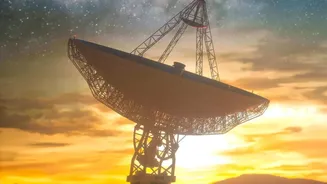
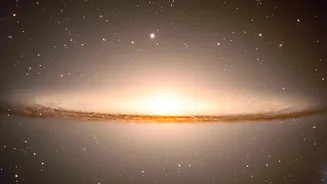
The consequence of filling the sky with hundreds of thousands of reflective objects is significant light pollution. Astronomers have been raising the alarm for years about existing satellite constellations, which create bright streaks across telescope images, compromising or ruining scientific data. An analysis found that even with tens of thousands of satellites, nearly 40% of images from the Hubble Space Telescope could be contaminated. With proposals for over a million satellites, some scientists warn that professional ground-based astronomy could become nearly impossible. The cumulative effect of so many satellites would not just be individual streaks, but a diffuse glow that could raise the overall brightness of the night sky, effectively drowning out faint stars and distant galaxies for everyone on Earth. For a person in a city, these satellites could one day be the only 'stars' visible.
Mitigation and the Regulatory Void
In response to criticism, some companies are exploring ways to make their satellites less bright. SpaceX, for example, has tested anti-reflective coatings and visors to shield shiny components. The International Astronomical Union (IAU), a key scientific body, has recommended that satellites should not be visible to the naked eye, setting a specific brightness limit (magnitude 7) as a target. However, most existing constellation satellites already exceed this recommended limit. The larger problem is that there are currently no international laws or binding treaties that specifically regulate the brightness of commercial satellites. The issue highlights a growing tension in space governance: who gets to decide the future of a resource that belongs to everyone? Without clear rules, the development of space risks privatizing the benefits while externalizing the costs to science and culture.