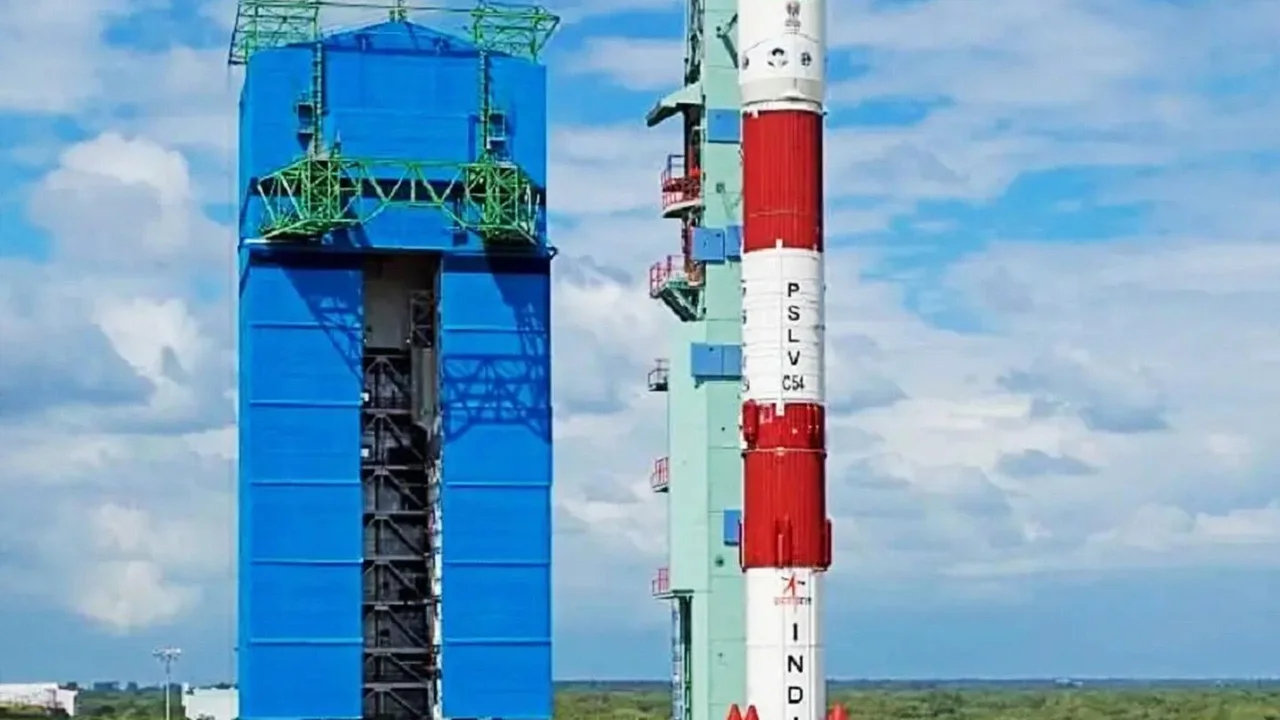





The Old Way: Expensive, Single-Use Rockets
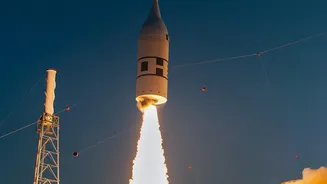
Think of a traditional rocket launch like buying a brand-new car, driving it once from Delhi to Mumbai, and then pushing it into the sea. That's essentially what happens with expendable launch vehicles. The most expensive parts of the rocket—the powerful
engines, complex fuel tanks, and sophisticated electronics—are used for a single flight before being discarded. This incredible waste is the primary reason launching anything into space has been historically expensive. The cost of fuel is a relatively small part of the total bill; the real expense is in the hardware itself, which can account for the majority of a mission's cost. This high price tag has limited what countries and companies can do, making space a domain accessible only to the most well-funded projects.
The Game-Changer: Reusability
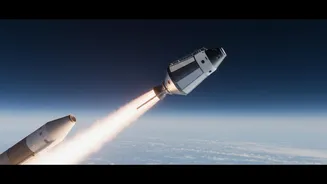
Reusable launch vehicles change this economic equation entirely. The concept is simple, much like a commercial airplane. Airlines don't build a new aircraft for every flight; they land, refuel, and reuse the same plane thousands of times, which spreads the manufacturing cost out and makes air travel affordable. Applying this logic to space travel is revolutionary. By designing a rocket's first stage—its largest and most expensive part—to return to Earth and land safely, it can be refurbished and flown again. Companies like SpaceX have already proven this model's success with their Falcon 9 rockets, which perform propulsive vertical landings. Reusability can slash the cost per launch, making it more feasible to deploy satellite constellations, conduct scientific research, and eventually, support more ambitious missions to the Moon and beyond.
ISRO's Approach: The Winged 'Pushpak'
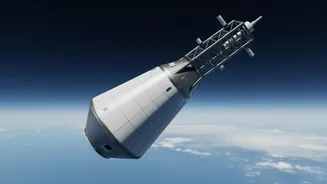
ISRO is taking a different, but equally valid, path towards reusability with its winged vehicle, named 'Pushpak'. Instead of landing vertically under rocket power, ISRO's Reusable Launch Vehicle Technology Demonstrator (RLV-TD) is designed to launch like a rocket and land like an aircraft. After its mission, the winged vehicle would re-enter the atmosphere and glide to a conventional runway for a horizontal landing. This is where the recent Landing Experiments (LEX) are so crucial. In a series of successful tests, ISRO dropped the uncrewed vehicle from a helicopter at a high altitude. The RLV then had to autonomously navigate its way to a designated runway and execute a perfect, high-speed landing—at over 320 kmph. Mastering this autonomous landing is the single most critical technology needed to make this spaceplane concept a reality.
Why the Autonomous Tests Are So Important
An autonomous landing is a monumental engineering challenge. The vehicle is returning from the harsh environment of space and must perform a series of complex manoeuvres without a human pilot. It relies on advanced guidance, navigation, and control systems to correct its path, manage its speed, and touch down precisely on target, even in challenging wind conditions. The success of ISRO's LEX missions demonstrates that its homegrown technologies—from navigation software to landing gear and brake parachutes—are capable of handling this demanding task. By proving the autonomous landing system works, ISRO has cleared a major hurdle on the path to developing its operational Two-Stage-To-Orbit (TSTO) launch vehicle, where the first stage will be a reusable winged vehicle that returns to base.
The Economic Impact for India
For India, the stakes are enormous. Achieving low-cost, reliable access to space is a cornerstone of the 'Aatmanirbhar Bharat' vision. A successful reusable launch system would allow ISRO to launch its own national satellites for communication, Earth observation, and defense far more cheaply. Furthermore, it would position India as a major player in the multi-billion dollar global commercial launch market. Satellite companies from around the world are constantly looking for more affordable ways to get their hardware into orbit. By offering a cost-effective, reusable launch service, India can compete directly with established international players, generating significant revenue and fostering a robust domestic space industry. This technology is the key to unlocking a new era of space commercialisation and exploration, led by India.