



An Appointment in the Sky
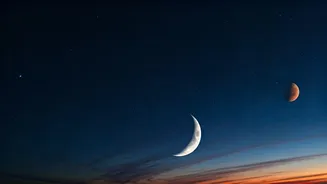
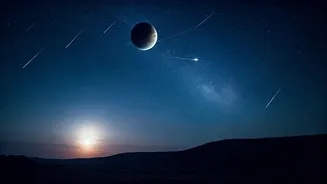
A conjunction is simply an event where two celestial objects appear close to each other in our sky. It's a line-of-sight trick, of course; the Moon and Saturn are millions of kilometres apart. But for us on Earth, it’s a beautiful and useful pairing.
The Moon is the brightest and easiest object to find. When it cozies up to a planet like Saturn, it acts like a giant, glowing signpost, pointing the way for you. This makes finding Saturn, which to the naked eye looks like a steady, yellowish, bright star, incredibly simple. You don’t need to know a single constellation to get started. Just find the Moon, and you’re most of the way there. This removes one of the biggest hurdles for beginners: the overwhelming feeling of not knowing where to even begin looking.
When and Where to Look
These celestial meetups happen regularly. For those in India, several opportunities arise throughout the year. For example, a notable conjunction occurs in mid-May 2026, when the crescent moon serves as a guide to finding Saturn in the pre-dawn sky. Another prominent event happens in late September 2026, when a near-full Moon will pass close by Saturn after sunset, making the planet very easy to spot. The best way to keep track is to use a free stargazing app on your phone. Apps like Stellarium can show you exactly when and where to look from your specific location in India, and they are invaluable tools for any budding astronomer. Simply point your phone at the sky, and it will identify everything for you.
The Only Gear You Need: Your Eyes
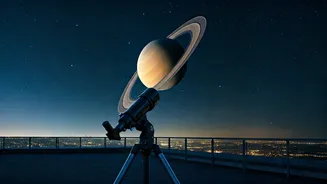
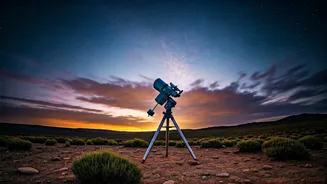
One of the most persistent myths in astronomy is that you need an expensive telescope. This is simply not true. You can enjoy a Moon-Saturn conjunction with no equipment at all. With just your eyes, you'll see the Moon and a bright, steady point of light nearby—that’s Saturn. Unlike stars, planets don't usually twinkle, which is how you can tell them apart. If you have a basic pair of binoculars, the view gets even better. While you won't see the rings distinctly, Saturn might appear as a tiny, slightly elongated or football-shaped object, which is thrilling in itself. A small telescope with as little as 25x to 30x magnification is where the magic happens, revealing the iconic rings that make Saturn so famous. But the journey starts with your eyes; everything else is an upgrade.
Your First Stargazing Session
Ready to try? First, find a spot away from the brightest city lights if you can, though even a city rooftop will work since the Moon and Saturn are very bright. Second, give your eyes about 20 to 30 minutes to adapt to the darkness; you'll see thousands more stars once they do. Avoid looking at your phone screen during this time, as the white light will reset your night vision. Once your eyes are adjusted, locate the Moon. Then, scan the area right next to it for a bright, non-twinkling 'star'. That's your target. Take your time observing it. Notice its colour and steadiness. If you have binoculars, brace your arms against a wall or car to keep them steady and take a closer look. The goal isn't to discover a new galaxy, but to have a personal moment of connection with the cosmos.
What You Are Actually Seeing
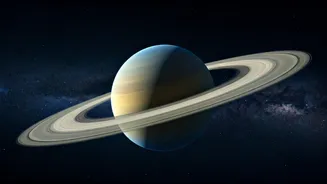
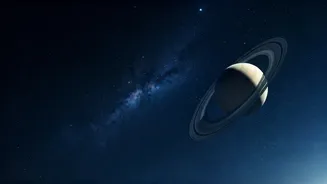
That tiny point of light is a gas giant nearly 1.5 billion kilometres away, a world so large that more than 760 Earths could fit inside it. And its rings, made of countless particles of ice and rock, stretch across a distance so vast you could line up five Earths in the main ring system. Even a basic telescope view that reveals those rings for the first time is an unforgettable experience that has hooked countless people on astronomy for life. With a slightly larger telescope, you might even spot Saturn's largest moon, Titan, which is bigger than the planet Mercury. Every glance is a reminder of the scale and wonder of our solar system, accessible right from your own backyard.