



More Than Just Pretty Pictures
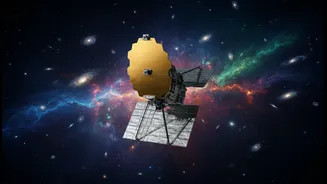
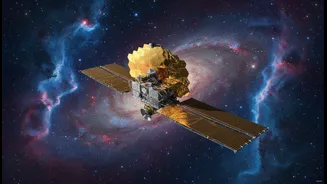
It has officially been four years since the James Webb Space Telescope (JWST) began its science operations, delivering images that have become cultural touchstones. From the glittering 'Cosmic Cliffs' of the Carina Nebula to the ghostly Pillars of Creation,
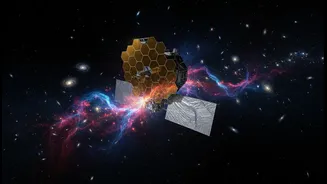
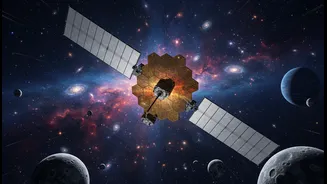
Webb's views are spectacular. But treating the $10 billion observatory as just a fancy camera misses the point entirely. Its true purpose was never just to take pretty pictures, but to answer questions that its predecessor, the Hubble Space Telescope, couldn't reach. Armed with a massive 6.5-metre mirror and the ability to see in infrared, Webb was designed to peer into the deepest, earliest moments of the universe. In just four years, it has done more than just deliver on that promise; it has forced a complete reassessment of our cosmic origin story.
Rewriting the Cosmic Dawn
Perhaps the most profound impact of JWST has been on our understanding of the early universe. According to prevailing cosmological models, the first galaxies should have taken time to form, appearing as small, clumpy, and immature structures. Webb has found the opposite. In its first year, it spotted galaxies like 'Maisie's Galaxy' that were fully formed, massive, and shining brightly just 390 million years after the Big Bang—far earlier and more developed than theory allowed. Initially, scientists were skeptical, but repeated spectroscopic confirmations proved these 'impossible' galaxies were real. These findings challenge the standard model of cosmology, suggesting that the processes of star and galaxy formation were far more efficient and rapid in the infant universe than anyone predicted.
Sniffing Alien Atmospheres
Webb has also transformed the study of exoplanets, shifting it from merely detecting distant worlds to actually analyzing what they're made of. By dissecting the starlight that filters through a planet's atmosphere, its instruments can identify individual molecules. One of its very first results was the unambiguous detection of carbon dioxide on the 'hot Saturn' known as WASP-39 b. It later found signs of photochemistry—chemical reactions triggered by starlight—by identifying sulfur dioxide in the same atmosphere. More recently, it provided the strongest evidence yet for an atmosphere around a rocky super-Earth and even found salt clouds on a bizarre 'Pink Planet'. This ability to inventory the chemicals on worlds light-years away is a critical step in the search for habitable environments beyond Earth.
A New Look at Our Neighbours
While famous for its deep-field images, Webb has also turned its golden eye on our own cosmic backyard with spectacular results. It has captured stunningly detailed images of Jupiter's auroras and immense storms, revealing atmospheric dynamics that were previously invisible. It has peered at Uranus and Neptune, providing the clearest views of their faint rings and atmospheric storms in decades. Webb has even studied the surface of moons like Europa, finding carbon that likely originated from its subsurface ocean—a key building block for life. And in a recent discovery, it may have detected a mysterious, unknown molecule on both Pluto and Saturn's moon Titan, highlighting how much we still have to learn about our own solar system.
The Real Story Is in the Questions
This torrent of data has been accompanied by breathless headlines. But the true significance of Webb isn't in finding a single 'God particle' or a definitive 'Earth 2.0.' Its value lies in the complexity it has unveiled. For its fourth anniversary, NASA released an unprecedented image of the galaxy Centaurus A, revealing the intricate interplay between a supermassive black hole and star formation. The black hole both triggers and stifles star birth simultaneously, a complex dance that defies simple explanation. Webb's discoveries—from early galaxies that are 'too big' to the 'Hubble tension' it confirmed—are valuable precisely because they create problems for science. They force us to ask better questions and admit that the universe is far stranger and more wonderful than our models had assumed.