

A Wave That Breaks the Rules
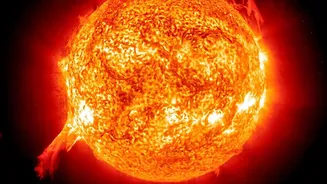
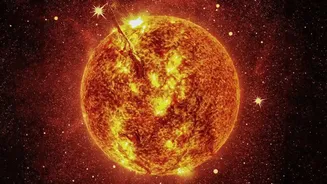
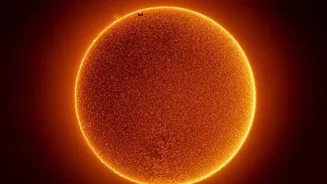
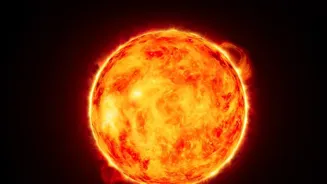
Scientists recently identified a strange new kind of acoustic wave on the Sun's surface that appears to break the known laws of physics. Dubbed high-frequency retrograde (HFR) vorticity waves, these phenomena travel in the opposite direction of the Sun's rotation.
What truly baffled researchers is their speed; they move three times faster than current theories predict is possible. Unlike other solar waves that can be explained by the effects of magnetism, gravity, or convection currents, these HFR waves do not seem to be caused by any of these known processes. This discovery was made after analysing 25 years of data from both space-based and ground observatories, suggesting a fundamental piece of solar physics has been missing from our understanding.
A Clue to the Coronal Heating Puzzle
One of the most persistent puzzles in solar physics is the coronal heating problem. The Sun's outer atmosphere, the corona, sizzles at temperatures of around one million degrees Celsius, while its visible surface, the photosphere, is a comparatively cool 6,000 degrees. This defies logic, as you would expect temperatures to decrease as you move away from a heat source. For decades, scientists have theorized that some unknown mechanism must be transporting vast amounts of energy into the corona. The discovery of the mysterious HFR waves provides a new, exciting possibility. Though their origin is unknown, scientists speculate that these waves, and the unexplained physics behind them, could be linked to the transport of energy that superheats the corona. Unlocking their secret could finally explain this 65-year-old mystery.
Peering Inside the Sun
Since we cannot see directly into the Sun's fiery interior, scientists rely on studying waves on its surface to infer what is happening beneath. This field, known as helioseismology, works similarly to how geologists use seismic waves to understand Earth's interior. The unusual nature of HFR waves suggests that there are processes occurring inside the Sun that we don't yet comprehend. According to Shravan Hanasoge, an astrophysicist at New York University Abu Dhabi, the very existence of these waves “may allude to exciting physics at play” and has the “potential to shed insight on the otherwise unobservable interior of the Sun.” These waves act as messengers from the depths, and deciphering their message could reveal new information about the Sun's internal dynamics and structure.
The Link to Space Weather
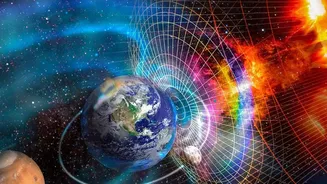
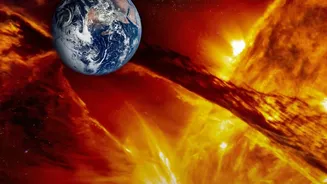
Understanding the Sun isn't just an academic exercise; it has practical implications for life on Earth. The Sun constantly releases a stream of charged particles called the solar wind. Violent events like solar flares and coronal mass ejections can supercharge this wind, sending powerful blasts of energy toward our planet that can disrupt satellites, damage power grids, and interfere with communication systems. By gaining a better understanding of the fundamental physics driving our star—including the processes that power these newly discovered waves—scientists can improve their models for predicting space weather. This knowledge is crucial for protecting our increasingly technology-dependent infrastructure from the Sun's powerful outbursts.
An Exciting New Set of Questions
Rather than providing immediate answers, the discovery of HFR waves has presented solar physicists with a tantalizing new set of questions. The fact that these waves do not fit existing models is what makes them so exciting for researchers. Chris Hanson, a solar physicist at New York University Abu Dhabi's Center for Space Science, noted that if the waves had been attributable to known processes, it would have answered some open questions. “However, these new waves don't appear to be a result of these processes, and that's exciting because it leads to a whole new set of questions.” This mystery promises to drive a new wave of research, pushing scientists to develop novel theories that could reshape our understanding not just of our own Sun, but of stars throughout the universe.