






A Landmark Discovery
In a major science update, astronomers confirmed the detection of an atmosphere around a super-Earth known as 55 Cancri e, a rocky planet 41 light-years away. This is one of the most significant findings to date in the search for worlds outside our solar
system. For the first time, we have clear evidence of a substantial atmosphere, likely rich in carbon dioxide or carbon monoxide, on a rocky planet. What makes this truly breathtaking is that the data also shows hints of water vapour, a crucial ingredient for life as we know it. While the planet itself is a scorching hellscape, this discovery proves that rocky worlds can hold onto their atmospheres, a key requirement for a planet to be potentially habitable.
Decoding Alien Air
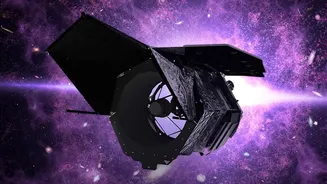
So how does the James Webb Space Telescope (JWST) see the air of a planet light-years away? It uses a technique called transmission spectroscopy. As a planet passes in front of its star from our perspective, a tiny fraction of the starlight shines through the planet's atmosphere. Different gases in that atmosphere absorb specific colours, or wavelengths, of light. JWST's highly sensitive infrared instruments capture this light and spread it out like a rainbow, creating a spectrum. The missing slivers in that rainbow, represented as dips in a graph, are the tell-tale fingerprints of molecules like carbon dioxide and water vapour. This technique allows scientists to effectively sniff the air of distant worlds without ever leaving our cosmic neighbourhood.
The 'Super-Earth' Enigma
The term 'super-Earth' might sound like a promise of a better version of our own world, but it simply refers to a planet's size and mass. Super-Earths are more massive than our planet but lighter than ice giants like Neptune. They are a common type of planet in our galaxy, yet intriguingly, there are no examples in our own solar system. This makes them a complete mystery. They could be larger, rocky versions of Earth, or they might be more like 'mini-Neptunes' with thick gas envelopes. The discovery on 55 Cancri e is so important because it’s the first solid evidence of a thick atmosphere on a rocky super-Earth, giving us a vital clue in understanding these enigmatic worlds.
Why Water Vapour Matters
Finding water anywhere beyond Earth is always a headline-grabber, and for good reason. It is the solvent for life on our planet, and its presence is considered a primary requirement in the search for habitable environments. The detection of water vapour, even on a planet as hostile as 55 Cancri e, is a technical triumph. It demonstrates that JWST can find the molecular building blocks for life on small, rocky planets. However, scientists are careful to manage expectations. The presence of water vapour doesn't automatically mean life. In some cases, the signal might even come from cool spots on the host star itself, a possibility that scientists are working hard to rule out in these new observations.
Not Earth 2.0 (Yet)
It is crucial to understand that 55 Cancri e is no paradise. It orbits its star so closely that its surface is a molten ocean of magma, with temperatures reaching over 2,000 degrees Celsius. It is tidally locked, meaning one side perpetually faces its star in eternal, blistering daylight. The atmosphere detected is likely a 'secondary' one, constantly being replenished by gases bubbling out of the magma ocean. So, why the excitement? Because this discovery is a proof of concept. It proves that a rocky planet can maintain a significant atmosphere even under intense stellar radiation. It’s a huge step toward the ultimate goal: finding a smaller, temperate, rocky world in its star's habitable zone and asking the same question: what’s in your air?