


Our Window to the Universe
July 2026 marks four years since the James Webb Space Telescope (JWST) delivered its first jaw-dropping images, fundamentally changing our view of the cosmos. Acting as a time machine, its powerful infrared instruments peer through cosmic dust and gas
to witness events that happened billions of years ago. The telescope doesn't just take beautiful pictures; it captures data that allows scientists to understand the universe in unprecedented detail. Each new release of images isn't just a prettier postcard from the void—it's a new chapter in the story of everything. Recent images continue this tradition, revealing the intricate processes that shape the heavens, from the birth of stars to the feeding habits of galactic monsters.
Cosmic Construction Zones
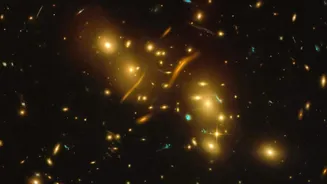
Among the latest revelations are breathtaking glimpses into cosmic construction sites. JWST recently imaged a galaxy cluster named MACS J0553.4-3342, showing it as it was 4.4 billion years in the past. This isn't a static object but a dynamic, active building site where two smaller galaxy clusters are in the process of merging. Such images provide a crucial window into how the largest structures in the universe are assembled. In other observations, Webb has peered into what scientists are calling cosmic 'factories' in the early universe. These were early galaxies pumping the infant cosmos full of stardust—the vital raw material for the next generation of stars, planets, and perhaps, life. By seeing these nurseries in action, we are essentially watching the universe build itself.
How to Feed a Monster
Every large galaxy, including our own Milky Way, hosts a supermassive black hole at its center. A long-standing mystery has been how these behemoths feed. Thanks to new JWST images released in late July 2026, we have our clearest view yet. The images show long, thin filaments of gas streaming from a galaxy's hot atmosphere down into the rotating disk of matter that fuels the central black hole. For decades, scientists hypothesized this process, but Webb's clarity has finally provided visual confirmation. It reveals a self-regulating cycle where the black hole's energy output heats surrounding gas, which then cools, condenses into filaments, and falls back to feed the beast. This is cosmic complexity in its most extreme form: a galactic-scale plumbing system that keeps the central engine running.
Echoes from the Dawn of Time
Perhaps the most profound power of the JWST is its ability to look back toward the very beginning. Just this week, astronomers announced the discovery of a primordial object that appears to be a newborn 'Little Red Dot,' or LRD. These LRDs are extremely distant, compact objects believed to be the seeds of the first galaxies, containing supermassive black holes. This particular object, located 12 billion light-years away, is a starburst galaxy in its first ten million years of existence. It is metal-poor, meaning it consists almost entirely of the hydrogen and helium forged in the Big Bang, but it is furiously forming new stars. Finding an LRD in its infancy is a fundamental step in understanding how the first galaxies, the ancestors of giants like our own, came to be.