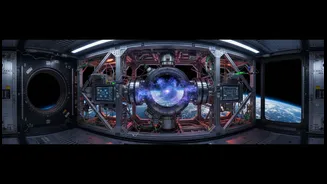




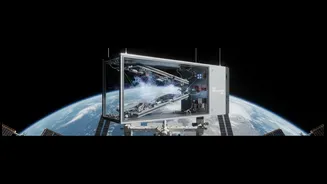


What is the Cold Atom Lab?
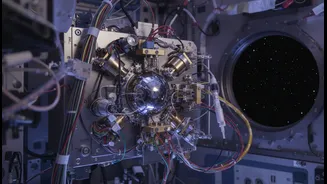
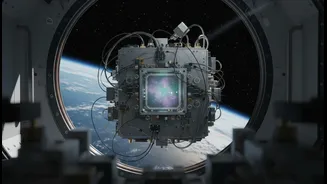
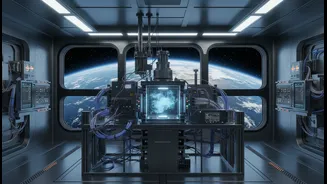
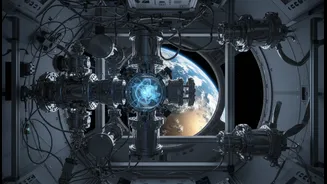
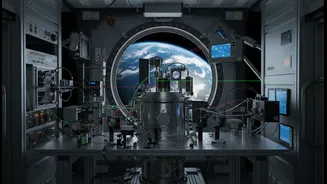
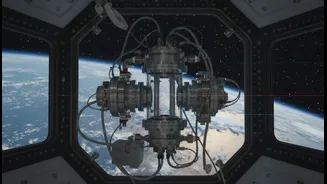
The facility at the heart of this revolution is NASA's Cold Atom Laboratory, or CAL. Launched to the International Space Station in 2018, it's a remotely operated physics lab designed to study the strange world of quantum mechanics. Its primary job is to cool
atoms down to temperatures just a fraction of a degree above absolute zero—more than a hundred million times colder than deep space. Why go to space to get cold? On Earth, gravity relentlessly pulls on atoms, limiting how long scientists can observe them. In the microgravity of orbit, these ultracold atom clouds can float for much longer, up to 10 seconds, allowing for unprecedented measurement and study. Recent upgrades, installed in 2026, have given the lab even more powerful tools, including redesigned magnetic traps and new atom sources, expanding the types of experiments scientists can perform.
Creating a Fifth State of Matter
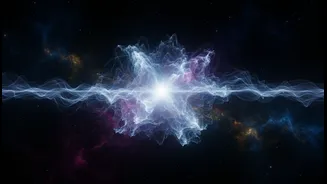
At these extreme temperatures, atoms slow to a near standstill and begin to overlap, merging into a single quantum entity known as a Bose-Einstein Condensate (BEC). First predicted by Satyendra Nath Bose and Albert Einstein in the 1920s, a BEC is often called the fifth state of matter, distinct from gas, liquid, solid, and plasma. In this state, the bizarre rules of the quantum world—where particles can act like waves and be in multiple places at once—become visible on a macroscopic scale. The atoms stop behaving like individual billiard balls and start acting like a single, coordinated 'super-atom'. The CAL was the first facility to produce a BEC in Earth orbit, and the microgravity environment allows these condensates to be studied in a purer form than is possible on the ground.
The Power of Precision Sensing
So, what's the point of making a BEC? This ultra-cold, wave-like matter is incredibly sensitive to its surroundings. This sensitivity is the key to a technology called quantum sensing. Using a technique known as atom interferometry, scientists can split a BEC wave in two, send the halves along different paths, and then recombine them. The slightest disturbance—a tiny change in gravity, time, or a magnetic field—will alter the final interference pattern in a measurable way. This allows for the creation of sensors with a level of precision that is simply impossible with classical technology. These sensors can measure forces with astonishing accuracy, opening up a new frontier of observation and measurement.
Real-World Revolutions on the Horizon
This is where the research leaves the lab and enters our lives. The precision of quantum sensors could lead to a host of transformative technologies. For India and the world, one of the most promising applications is in geodesy, or mapping Earth's gravity. These sensors could detect underground aquifers to combat water scarcity, identify undiscovered mineral deposits without expensive drilling, and monitor magma chambers beneath volcanoes to better predict eruptions. They could also enable navigation systems that don't rely on GPS, a critical advantage for aviation, shipping, and defense, especially in remote or contested areas. In healthcare, similar principles could lead to more advanced brain imaging and other non-invasive diagnostics.
What's Next for Quantum in Orbit?
The work being done on the Cold Atom Lab is part of what some scientists call the 'second quantum revolution'. The first gave us lasers, transistors, and MRI machines—technologies based on quantum effects. This new phase is about directly manipulating quantum states to create entirely new capabilities. The CAL serves as a vital proving ground, demonstrating that complex quantum instruments can operate reliably in space. The long-term vision includes creating networks of quantum sensors, potentially leading to more secure communications and a deeper understanding of fundamental physics, like the nature of dark energy and gravity itself.