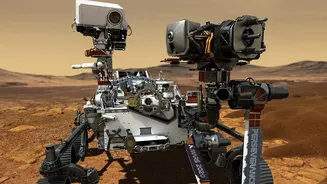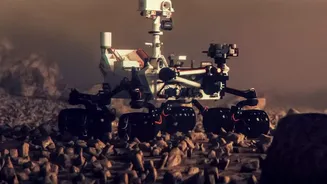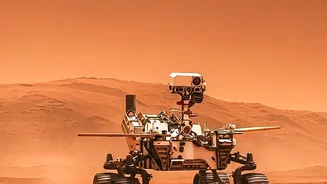







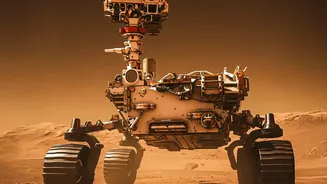
The audacious quest to bring the first pristine samples of Martian rock and soil to Earth has a new callsign: PSRA. NASA has revealed a major strategic review, signaling a crucial pivot for one of the most ambitious projects in human history.
The Ultimate Souvenir
For years,
bringing a piece of Mars to Earth has been a top priority for planetary scientists. The goal is to analyze Martian rocks and atmosphere in advanced laboratories that are far too large and complex to send into space. These samples, meticulously collected by the Perseverance rover since its landing in 2021, could hold the key to answering one of humanity's biggest questions: did life ever exist on Mars? Perseverance has been diligently drilling, collecting, and storing samples in sealed tubes, creating a treasure trove of geologic history in Jezero Crater. It has successfully cached dozens of samples, representing a diverse collection of Martian geology, ready for a future pickup.
A Plan Hits a Wall
The original plan for retrieving these samples was a complex, multi-national affair. In partnership with the European Space Agency (ESA), the Mars Sample Return (MSR) campaign involved a suite of spacecraft: a Sample Retrieval Lander would deploy a separate 'fetch rover' to collect the tubes, which would then be loaded onto a Mars Ascent Vehicle (MAV) and launched into orbit. An orbiter would then capture this payload and fly it back to Earth. But as the complexity grew, so did the price tag. Independent reviews saw the mission's cost swell to a staggering $11 billion, with a return date pushed back to 2040, a timeline and budget NASA itself deemed unworkable. The ambitious mission was at risk of collapsing under its own weight.
Introducing the PSRA Initiative
Faced with these challenges, NASA has initiated a strategic reset. On November 9, 2026, the agency announced the Perseverance Sample Retrieval Architecture, or PSRA. This is not a new, finalized blueprint but rather the formation of a dedicated team tasked with finding a more affordable, efficient, and timely way to get the samples home. The PSRA team will officially kick off its work in January 2027, with the mandate to review all prior lessons, assess current capabilities, and develop impartial recommendations for a new mission architecture. Their final report, expected in late 2027 or early 2028, will outline the new path forward for the MSR campaign.
Rethinking the Architecture
The PSRA's primary task is to simplify. One of the key changes considered in earlier reviews, and likely a central focus for the PSRA, involves leveraging the remarkable longevity and performance of the Perseverance rover itself. Instead of relying on a separate fetch rover to retrieve the cached samples, a revised plan could see Perseverance driving the samples directly to the lander. This would eliminate an entire robotic system and a major point of potential failure. The PSRA will evaluate this and other options, looking at every component of the mission to reduce cost and complexity while maintaining scientific integrity and a high probability of success.
A New Space Race?
The push to streamline the MSR mission isn't just about budget discipline; it's also happening in a new era of international space exploration. Another major space power, China, is moving forward with its own ambitious Mars sample return mission, Tianwen_3. Current plans project a launch around 2028, with the potential to bring back the first Martian samples by 2031. This adds a sense of urgency and competitive pressure to NASA's efforts, as the distinction of being the first nation to return samples from Mars is a significant prize. While NASA officials focus on the scientific and engineering challenges, the international context undoubtedly informs the need for a more robust and achievable timeline.