




Plan Before You Purchase
The first step to a budget-friendly pookalam is planning. Before you even think about buying flowers, decide on your design. Sketching a pattern on paper helps you estimate how many flowers you'll actually need, preventing over-buying. Start small, especially
if you're a beginner; a compact, dense design often looks more impressive than a large, sparse one. Traditional circular or geometric patterns are great for beginners and can be scaled to any size. Use chalk to lightly draw your final design on a clean floor surface before you begin filling it in. This ensures your pattern remains symmetrical and saves you from wasting precious petals on mistakes.
Choose Your Flowers Wisely
Not all flowers are created equal when it comes to cost. Marigolds (jamanthi), available in bright yellows and oranges, are a budget pookalam's best friend. They are affordable, long-lasting, and sold in bulk during the festive season. Chrysanthemums (sevvanthi) and rose petals are other cost-effective options that add variety in colour and texture. Instead of opting for expensive, exotic blooms, consider using flowers from your own garden, like hibiscus or jasmine. Visiting a local flower market early in the morning can also lead to better prices and fresher picks compared to boutique florists.
Embrace the Power of Green
One of the best ways to reduce flower costs is to incorporate more leaves into your design. Green provides a beautiful, natural contrast and can fill large areas of your pookalam without straining your wallet. You can use whole leaves to create borders or chop them finely to create a textured green filling. Woven coconut leaf strips can be used to create a unique grid-like frame for your design instead of the traditional circular rings. Don't be afraid to make green the dominant colour, using flowers as vibrant highlights rather than the main component. This approach not only saves money but also gives your pookalam a lush, eco-friendly feel.
Get Creative with Non-Floral Fillers
A pookalam is traditionally made of flowers, but you can supplement your design with other natural and household materials to great effect. Coloured sawdust, salt, or rice can be used to fill in sections of your pattern, offering a uniform texture and vibrant hue at a very low cost. For competitions, check the rules, but for home decorations, feel free to innovate. Some designs even use black sesame seeds for sharp, dark details, like in a Kathakali-themed pookalam. These alternatives are perfect for creating intricate details or filling large background spaces, allowing your flowers to be the stars of the show.
Simple Designs, Maximum Impact
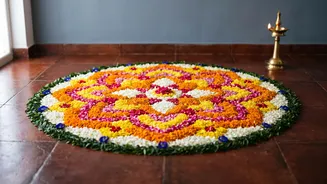
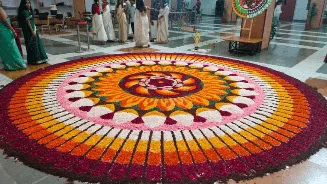
A budget doesn't limit you to boring designs. Some of the most striking pookalams are the simplest. A minimalist mandala or spiral pattern using just two or three contrasting colours, like yellow and white, can be incredibly elegant. Consider a design with concentric circles, filling each ring with a different affordable flower or coloured leaf. Another idea is a geometric pattern using squares or triangles, which creates a modern look and is easy to fill systematically. Even a simple, single large flower motif at the centre of a leafy base can create a powerful focal point. The key is clean lines and good colour contrast.
Make Your Creation Last
Once your masterpiece is complete, you'll want it to stay fresh as long as possible. Traditionally, a new layer of flowers is added each day of Onam. To keep your existing design vibrant, gently sprinkle it with water a few times a day, especially if it's in a warm area. This helps the petals retain moisture and colour. If possible, place your pookalam in a spot that is away from direct sunlight and strong breezes. To add a final festive touch, you can place traditional lamps (nilavilakku) or small diyas around your design in the evening, casting a warm, celebratory glow.