

The Gathering Storm
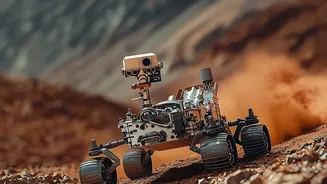
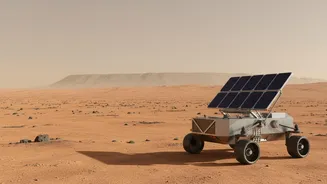
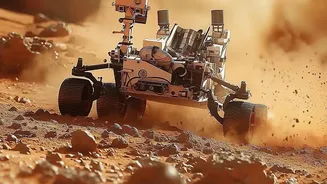
On Mars, dust is more than just a nuisance; it’s a potential mission-killer. Fine particles, kicked up by winds, can form continent-sized storms that blot out the sun for weeks. For solar-powered craft like the InSight lander or the legendary Opportunity
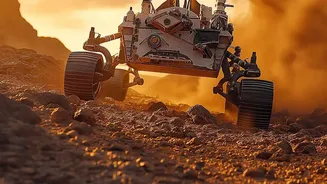
rover, this is a death sentence. As a thick haze of dust fills the atmosphere, sunlight struggles to reach the solar arrays that power the vehicles. Worse, when that dust settles, it forms a fine layer on the panels, progressively choking their ability to generate electricity. This slow suffocation by dust ultimately led to the end of the InSight mission in 2022 and the Opportunity rover in 2018 after it was engulfed by a global dust event. Protecting these multi-billion dollar assets is paramount, and that starts with knowing when a storm is coming.
A Weather Watcher in Orbit
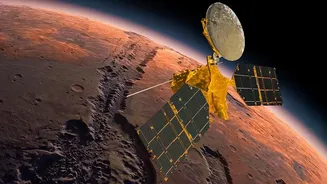
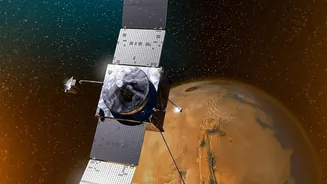
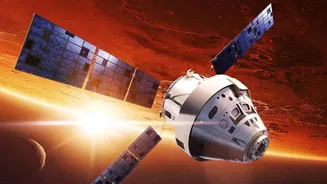
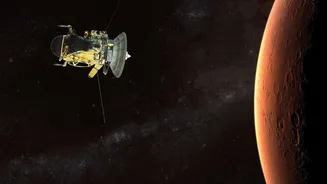
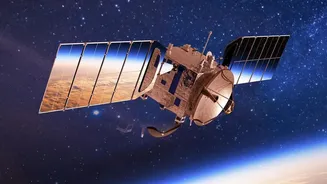
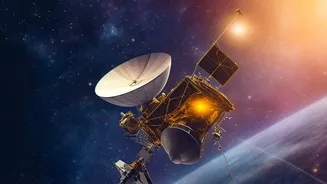
The key to early warnings lies high above the Martian surface with a fleet of orbiters. For years, spacecraft like NASA's Mars Reconnaissance Orbiter (MRO) have been the planet's primary meteorologists. The MRO is equipped with a suite of powerful instruments, but its most crucial tool for storm tracking is the Mars Color Imager (MARCI). This wide-angle camera captures a complete, color map of the planet every single day. By stitching these daily snapshots together, scientists can watch weather patterns unfold in near-real-time. They can see small, localized dust storms kick up and track them as they grow and merge into regional, or even global, events. This constant surveillance provides the first line of defense for the rovers and landers far below.
From Images to Actionable Intel
Having daily pictures is one thing; turning them into a reliable forecast is another. This is where advanced data analysis comes in. Scientists don’t just look at the photos; they use instruments like the MRO's Mars Climate Sounder to measure atmospheric temperature changes associated with rising dust. Dust absorbs sunlight, which heats the atmosphere and causes the storm to expand. By monitoring these temperature shifts, teams can gauge a storm's intensity and predict how fast it might spread. This analysis provides mission controllers on Earth with crucial warnings. When a storm is detected heading towards a lander, teams can take proactive measures, like commanding the craft to enter a low-power "safe mode" to conserve energy until the sky clears.
The Rise of AI Forecasters
The next frontier in Martian meteorology involves handing over the data analysis to artificial intelligence. Researchers are now developing deep-learning models, such as mask regional convolutional neural networks, to automatically detect and map dust storms from orbiter imagery. By training these AI systems on years of data from the Mars Dust Activity Database, they can learn to identify the tell-tale signs of storm formation with incredible speed and accuracy. This automated approach allows for a more systematic and rapid analysis than humanly possible, promising to make forecasts even more reliable. This could be a critical step in creating a robust weather prediction system for the Red Planet, combining satellite observations with climate models in a process known as data assimilation.
Forecasting for the Future
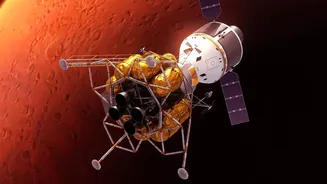
This isn't just about protecting our current robotic explorers. As humanity sets its sights on sending astronauts to Mars, reliable weather forecasting becomes an absolute necessity. Future human habitats will almost certainly rely on large solar arrays for power. A global dust storm that reduces energy output by over 90%, as seen during the 2018 storm, would be catastrophic for a crewed mission. Furthermore, dust storms pose risks to landing procedures and the health of surface equipment. The ability to predict these events weeks or even months in advance will be fundamental to the safety and success of human exploration. The work being done today with orbiters like the MRO is laying the essential groundwork for ensuring our future on the Red Planet is a safe one.