







The Viral Social Media Myth
You have likely seen the posts on WhatsApp, Facebook, or Twitter. They arrive every year, dressed up with scientific-sounding language, warning of an impending “aphelion phenomenon.” The claim is that because the Earth will be at its farthest point from
the Sun, our planet will experience a prolonged period of cold weather, impacting health and daily life. These messages often urge people to stock up on vitamins to boost their immunity against flu and coughs brought on by the supposed chill. While the terminology sounds plausible, the conclusion is entirely false and represents a fundamental misunderstanding of what drives our planet’s climate.
Reality Check: What Is Aphelion?
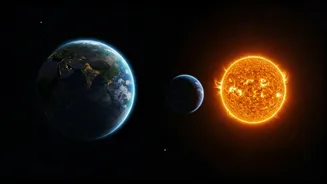
Aphelion is a real astronomical event. The term comes from the Greek words 'apo' (away) and 'helios' (sun). It marks the point in Earth’s orbit when it is farthest from the Sun. This happens because our planet’s orbit is not a perfect circle, but a slight ellipse. On July 6, 2026, Earth will reach aphelion, placing it approximately 152.1 million kilometers from the Sun. This is contrasted with perihelion, which occurs in early January, when Earth is closest to the Sun at about 147 million kilometers. While a difference of about 5 million kilometers sounds enormous, it only represents about a 3% variation in our distance from the Sun over the course of a year.
Tilt, Not Distance: The Real Cause of Seasons
The persistent myth of aphelion causing cold weather stems from a simple, intuitive, but incorrect assumption: that our distance from the Sun determines our seasons. If this were true, the entire planet would experience winter in July and summer in January. We know this is not the case. The real driver of the seasons is the tilt of Earth’s rotational axis, which is angled at about 23.5 degrees. It is this tilt, not our proximity to the Sun, that dictates why the Northern Hemisphere experiences summer while the Southern Hemisphere has winter, and vice versa.
Why It's Hot in July, Even at Aphelion
During July, the Northern Hemisphere is tilted toward the Sun. This means the Sun's rays hit this part of the Earth more directly and for longer periods each day. Think of a flashlight beam: when you shine it directly onto a surface, the light is concentrated and intense. When you shine it at an angle, the light spreads out and is less intense. The directness of the sunlight is the key factor. The Northern Hemisphere, including India, receives more concentrated solar energy during its summer months, leading to higher temperatures. The fact that this coincides with aphelion, when we are slightly farther from the sun, is proof of just how dominant the axial tilt is in shaping our climate. The minor increase in distance has a negligible cooling effect compared to the immense warming effect of the direct solar radiation.
A Curious Wrinkle in Global Temperatures
Interestingly, and somewhat paradoxically, the Earth's overall average temperature is actually slightly higher during aphelion in July than during perihelion in January. This is not because being farther from the Sun makes us warmer, but because of the uneven distribution of land and water on Earth's surface. The Northern Hemisphere has significantly more landmass than the Southern Hemisphere. Land heats up much more quickly and easily than water. So, when the land-heavy Northern Hemisphere is tilted towards the Sun in July, the global average temperature gets a slight boost, even though the planet as a whole is receiving about 7% less solar energy than it does in January. This further debunks the idea that aphelion brings a global cold spell.