





A Star's Final Act
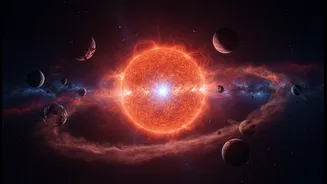
Like all stars, our Sun has a finite lifespan. In about five billion years, it will exhaust the hydrogen fuel in its core and begin to die. This process will see it swell into a red giant, a star hundreds of times its current size. This expansion will be catastrophic
for the inner solar system, with the Sun expected to engulf and destroy Mercury and Venus. Earth's fate hangs in the balance; it might be consumed, or it might be pushed into a wider orbit as the Sun sheds mass. After this violent phase, the Sun's outer layers will drift away, leaving behind a small, super-dense, Earth-sized core called a white dwarf—the smouldering ember of a once-mighty star.
A Survivor Against the Odds
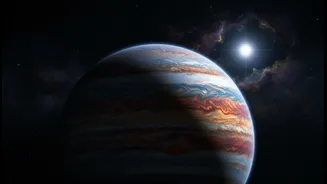
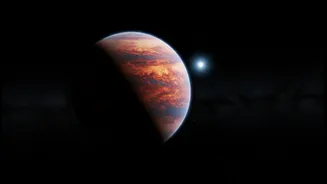
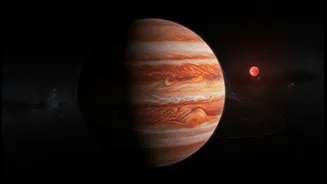
Eighty light-years away, a planetary system offers a glimpse into this very future. It features a Jupiter-sized planet, named WD 1856 b, orbiting a white dwarf. The arrangement is bizarre: the planet is seven times larger than the dead star it circles. What truly puzzled scientists, however, was the planet's orbit. It whips around the stellar corpse every 34 hours, placing it 50 times closer to its star than Earth is to the Sun. At that proximity, it should have been obliterated when its star swelled into a red giant billions of years ago. Its survival was a cosmic mystery demanding an explanation.
Solving a Cosmic Puzzle
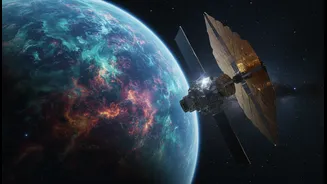
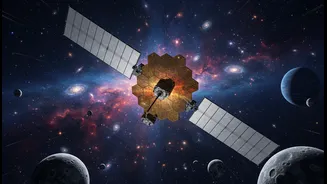
The James Webb Space Telescope (JWST) provided the crucial clues. By observing the planet as it passed in front of its star, astronomers were able to analyze its atmosphere for the first time—a landmark achievement for a planet orbiting a dead star. The data revealed the presence of hydrocarbons, likely methane, but also a surprise: the planet was significantly warmer than expected. Since the white dwarf provides little heat, this warmth had to be residual energy from a past event. The leading theory is that WD 1856 b was not always so close. It likely survived the red giant phase in a wide, safe orbit, only migrating inward billions of years later. The immense gravity of the white dwarf would have heated the planet during this inward spiral, and it has been cooling ever since.
A Preview of Our Own Future
The story of this surviving planet acts as a time machine, offering a preview of our own solar system's distant future. While the inner planets face destruction, gas giants like Jupiter and Saturn are expected to survive the Sun's death. The case of WD 1856 b suggests that these survivors won't just drift in the cold darkness. Instead, complex gravitational interactions could cause them to migrate inward over billions of years, embarking on a second life in a completely reconfigured solar system. These discoveries transform the abstract concept of our cosmic endgame into something scientists can actively study today. Instead of just models, we now have real-world examples of what happens after a star dies.
A New Frontier for Life?
The existence of these post-death planetary systems opens up fascinating new possibilities. While a white dwarf is a stellar remnant, it still radiates heat for trillions of years. This creates a small but stable habitable zone where a rocky planet could potentially maintain liquid water. However, the challenges are immense. A young, hot white dwarf emits intense radiation that could strip a planet's water away. Despite the hurdles, the idea that life could find a way, or experience a second genesis, around the embers of a dead star is a poetic and powerful one. The discovery of survivor planets like WD 1856 b is the first step in exploring this new frontier, searching for signs of vibrant futures around the quietest stars in the cosmos.