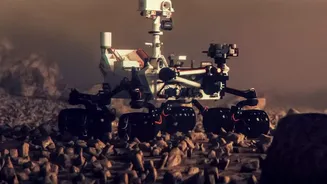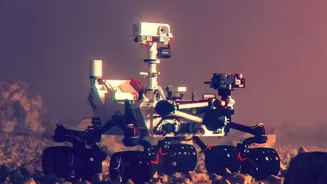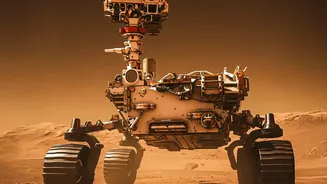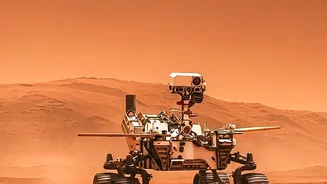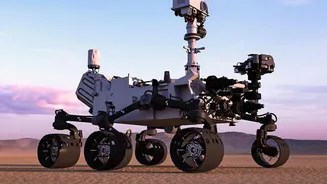





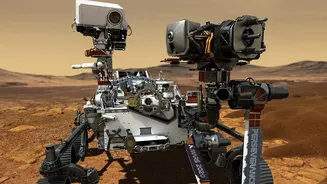

For the first time, NASA has a new, focused plan to bring pieces of another world to Earth. The newly announced PSRA is the agency's revised strategy for retrieving the precious samples collected by the Perseverance rover on Mars.
A Fresh Blueprint for a Historic Task
NASA has initiated the
Perseverance Sample Retrieval Architecture (PSRA), a new effort to tackle one of the most complex challenges in the history of space exploration: bringing Martian rocks, soil, and atmosphere back to Earth. Announced on November 9, 2026, by Tiffany Morgan, the director of NASA's Mars Exploration Program, this plan represents a crucial pivot. The original Mars Sample Return (MSR) mission, a collaboration with the European Space Agency (ESA), had become bogged down by an escalating price tag, projected to reach as high as $11 billion, with a return date pushed back to 2040. NASA Administrator Bill Nelson deemed this unacceptable, stating the cost was 'too expensive' and the timeline 'too far away'. The PSRA is NASA's official response, a mandate to develop a faster, cheaper, and less complex mission architecture.
Why a New Plan Was Necessary
The previous MSR concept was a multi-stage interplanetary relay of unprecedented complexity. It involved a lander, a fetch rover to collect the samples, and a Mars Ascent Vehicle (MAV) to launch them into orbit, where another spacecraft would capture them for the long journey home. An independent review board found that this intricate design faced significant budgetary and scheduling hurdles. In response, NASA was forced to rethink its approach, leading to the creation of the PSRA initiative. This new team, set to kick off its work in January 2027, will evaluate all options, including leveraging commercial partners and proven technologies to streamline the process. The goal is to have a final report and a clear strategy by the winter of 2027-2028, aiming for a sample return in the 2030s.
The Precious Cargo from Jezero Crater
Since landing in February 2021, the Perseverance rover has been meticulously collecting a diverse portfolio of samples from Mars's Jezero Crater, an ancient lakebed believed to have once been habitable. The rover has gathered dozens of samples, including cores of igneous and sedimentary rock, regolith (broken rock and dust), and even a sample of the Martian atmosphere. These samples are sealed in ultra-clean tubes. Some are stored aboard the rover itself, while a backup set of ten tubes was strategically dropped on the surface at a depot named 'Three Forks' to provide retrieval flexibility for a future mission. These samples are like a time capsule, potentially holding clues to the planet's geologic history and, most tantalizingly, whether life ever existed on Mars.
The Search for Ancient Life and Future Safety
The ultimate scientific prize is to analyze these Martian materials in sophisticated laboratories on Earth with instruments far too large and complex to send to Mars. Scientists hope to find biosignatures—traces of past microbial life—preserved in the rocks from Jezero's river delta. Beyond the search for life, the samples serve another critical purpose: astronaut safety. Analyzing the Martian soil for hazardous compounds, such as perchlorates, is essential to understand the risks future human explorers might face. This analysis will help design better suits and hardware for the first crewed missions to the Red Planet. There's also a geopolitical element, as China is moving forward with its own Tianwen-3 sample return mission, aiming to launch around 2028 and return samples by 2031, adding a sense of urgency to NASA's efforts.