






A Groundbreaking Discovery
The James Webb Space Telescope has identified water vapour in the inner disk of a young star system known as PDS 70, located 370 light-years away. This is significant because this is the region where rocky, Earth-like planets are thought to assemble.
While astronomers have found water in other celestial environments, detecting it in the terrestrial, planet-forming zone of a disk already known to host planets is a first. The finding was made by an international team using Webb's powerful Mid-InfraRed Instrument (MIRI), which can peer into the dusty cradles of stars. This system is relatively old for one with a planet-forming disk, making the presence of water surprising to scientists.
How Webb 'Sees' Water
JWST doesn't see water in the way we see steam from a kettle. Instead, it uses a technique called spectroscopy. Its highly sensitive instruments, like the Near-Infrared Spectrograph (NIRSpec) and MIRI, capture light that has passed through or been emitted by cosmic objects. Every chemical element and compound, including water, absorbs and emits light at specific wavelengths, creating a unique 'fingerprint' or 'signature' in the light's spectrum. By analysing this spectrum, astronomers can identify the chemical makeup of distant atmospheres and gas clouds. In the case of PDS 70, MIRI detected the distinct signature of hot water vapour, registering at a temperature of around 230 degrees Celsius.
Why This Finding Matters
Water is a fundamental ingredient for life as we know it, so finding it in a place where Earth-like planets could be forming is incredibly exciting. It suggests that the raw materials for habitable worlds might be common across the galaxy, available from the very beginning of a planet's formation. Before this, some scientists theorised that the harsh radiation from a young star would destroy any water in its inner disk, creating a dry environment for planet formation. This discovery challenges that idea, showing that water can not only exist but persist in these zones, potentially shielded by dust and other molecules.
Solving a Cosmic Delivery Problem
One of the big questions in planetary science is how Earth got its water. This discovery provides crucial clues. Scientists are exploring two main possibilities for the water in the PDS 70 system. One theory is that hydrogen and oxygen atoms are combining to form water molecules right there in the hot inner disk. Another idea is that ice-coated dust particles are migrating inward from the colder, outer regions of the disk, delivering water as they cross the 'snow line' and the ice turns to vapour. Understanding which of these processes is dominant will help explain how water is supplied to young, rocky planets throughout the universe.
The Power of a New Eye on the Sky
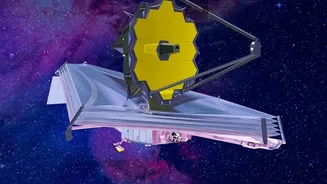
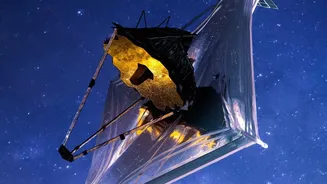
This detection was only possible because of the unique capabilities of the JWST. Its location in space, massive mirror, and advanced infrared instruments give it the sensitivity and resolution needed to probe these dense, dusty regions that were inaccessible to previous telescopes like Hubble. Astronomers have long suspected water should be present in these disks, but Webb is the first observatory powerful enough to gather unambiguous proof. This finding serves as a powerful demonstration of the telescope's ability to tackle some of the biggest questions about our cosmic origins and the search for life elsewhere.