




The Universe as a Time Machine
It sounds like science fiction, but it’s a fundamental truth of our universe. Light, though incredibly fast, takes time to travel. It zips through the vacuum of space at nearly 3,00,000 kilometres per second. That means the light from our own Sun takes about
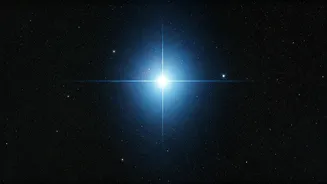
eight minutes to reach us. If the Sun were to suddenly vanish, we wouldn’t know for eight whole minutes. Now, extend that concept to the stars. The nearest star system to ours, Alpha Centauri, is about 4.3 light-years away. The light we see from it tonight left when you were about four years younger. This is the core idea of 'cosmic time travel.' The farther away an object is, the further back in time we are looking. The headline says 'centuries,' and that’s true for many stars in our stellar neighbourhood. But the universe allows us to look back much, much further.
A Glimpse into a Stellar Nursery
Let’s start with a classic cosmic landmark: the Orion Nebula. Visible even to the naked eye as a fuzzy patch in Orion’s sword, this stunning cloud of gas and dust is a stellar nursery where new stars are being born. It’s located roughly 1,344 light-years away from Earth. This means the beautiful, glowing light we see from it tonight began its journey toward us around the 7th century AD. Think about what was happening in India back then. The Pallava dynasty was flourishing in the south, the great university at Nalanda was a global centre of learning, and the Chalukya king Pulakeshin II was ruling from his capital in Badami. All the while, photons from this cosmic cloud were silently trekking across space, destined to arrive over 1,300 years later to be captured by our eyes and telescopes. When we marvel at the Orion Nebula, we are witnessing a scene from India’s classical age.
Meeting Our Galactic Neighbour
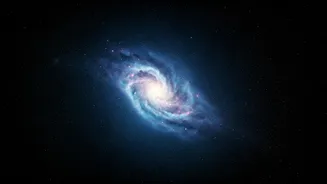
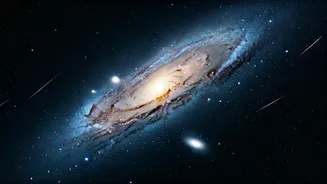
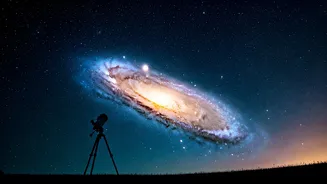
Ready to take a bigger leap back in time? Look toward the Andromeda Galaxy. On a clear, dark night, far from city lights, you can spot it as a faint, elongated smudge. This is our closest major galactic neighbour, but 'close' is a very relative term in space. Andromeda is 2.5 million light-years away. The light from this entire galaxy of a trillion stars started its journey when our earliest human ancestors, like *Homo habilis*, were first walking the Earth and crafting primitive stone tools. The entire story of modern humanity—the development of language, the rise and fall of empires, the invention of agriculture and the internet—all happened while this light was already on its way. When you look at Andromeda, you are seeing it as it was 2.5 million years in the past. It’s a profound, humbling connection to a time before human history as we know it.
Peering into the Cosmic Dawn
Modern observatories like the James Webb Space Telescope (JWST) are designed to push this principle to its absolute limit. They are powerful time machines capable of spotting light from the very first galaxies that formed after the Big Bang. JWST has detected galaxies whose light has been travelling for over 13.4 billion years. That's light that began its journey when the universe itself was just a toddler, only a few hundred million years old. This isn't just a spectacle; it's crucial science. By studying this ancient light, astronomers can piece together the story of cosmic evolution. They can watch how the first stars ignited and how galaxies grew and merged over billions of years. We are not just seeing faint, reddish smudges; we are witnessing the birth of cosmic structure itself, seeing the universe as it was in its infancy.