


An Icon with a Question Mark
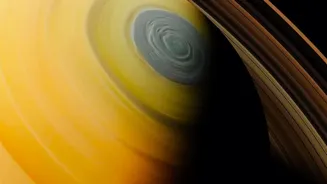
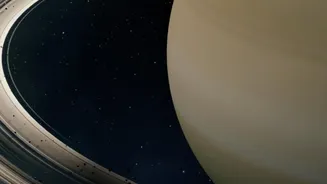
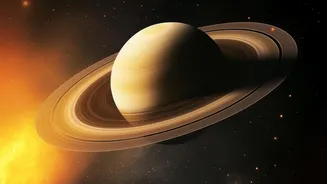
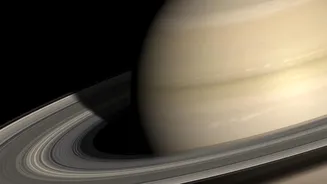
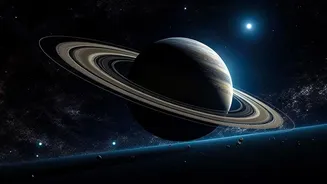
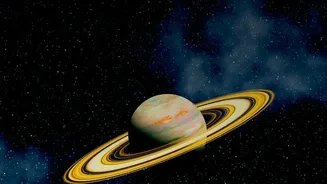
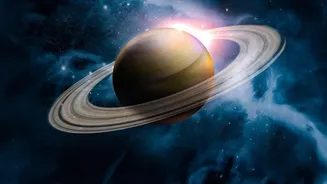
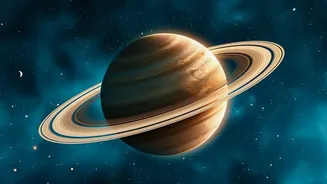
Since Galileo first observed them as strange 'handles' in 1610, Saturn's rings have captivated astronomers and stargazers alike. They appear timeless and permanent, a vast, shimmering disk of ice and rock. For a long time, the prevailing theory was that
the rings were primordial, having formed 4.5 billion years ago along with Saturn itself. It seemed logical; the rings look so integral to the planet, it was hard to imagine it without them. This assumption held for decades, shaping our understanding of the gas giant. But science is a process of questioning, and a major question lingered: were the rings really as ancient as they seemed?
Cassini's Detective Work
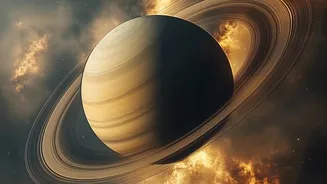
The game-changer was NASA's Cassini spacecraft, which orbited Saturn for 13 years. Its 'Grand Finale' in 2017, a series of daring dives between the planet and its rings, provided an unprecedented look at the system. By measuring the gravitational pull of the rings, scientists could finally calculate their mass accurately. The result was surprisingly low. This was a critical clue. The logic is that over billions of years, the rings should have accumulated a significant amount of dark, dusty pollution from constant bombardment by micrometeoroids. But Cassini found the rings to be remarkably clean—over 95% pure water ice. A low mass and a clean appearance suggested they simply hadn't been around long enough to get dirty or more massive.
A Fleeting Cosmic Beauty
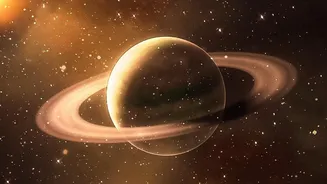
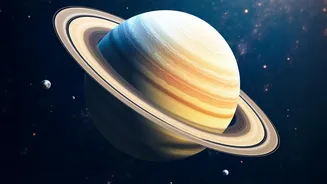
This evidence pointed to a stunning conclusion: Saturn's rings are young. Instead of being billions of years old, studies based on Cassini's data estimate their age at no more than 100 to 400 million years. This means the rings may have formed when dinosaurs still roamed the Earth, a mere blink of an eye in cosmic time. Adding to the drama is the discovery that the rings are disappearing. Cassini observed a phenomenon dubbed 'ring rain', where icy particles from the rings are pulled into Saturn's atmosphere by its magnetic field. At the current rate, the entire ring system could be gone in another 100 million years or so. We are, it seems, living in a privileged era, a brief window when Saturn is adorned with its spectacular halo.
The Origin Story Debate
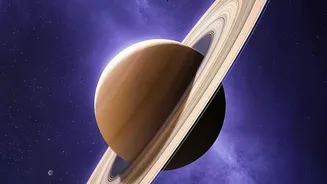
Knowing the rings are young solves one mystery but opens another: how did they form? If they weren't there from the beginning, something dramatic must have happened relatively recently. Several theories are being explored. One leading hypothesis suggests the rings are the shattered remains of an icy moon that strayed too close to Saturn and was torn apart by the planet's immense gravity. Computer simulations support the idea that a collision between two precursor moons could have created the debris field we see today. One compelling theory even names the hypothetical lost moon 'Chrysalis', suggesting it was destroyed about 160 million years ago, a timeline that fits well with the rings' estimated age. But the debate is far from settled, with some recent models arguing that self-cleaning processes could make ancient rings appear young, re-opening the entire question.
Science as a Journey
The evolving story of Saturn's rings is a perfect illustration of how planetary science works. It's not a set of memorized facts but a dynamic process of discovery. Each new mission and every new piece of data allows us to refine our understanding, challenge old assumptions, and ask better questions. The 'answer' is often a more sophisticated question. This same process is playing out across the solar system, from understanding Mars's ancient watery past to exploring the icy moons of Jupiter and the distant objects in the Kuiper Belt. Science is never truly finished because the universe always has more secrets to reveal. The questions we answer today only pave the way for the mysteries we will explore tomorrow.