




Meet the Ghost Particle
Imagine a particle so uninterested in the world that billions of them pass through your body every second without a trace. That is the neutrino. With almost no mass and no electric charge, these 'ghost particles' travel across the cosmos in straight lines,
unaffected by the magnetic fields and cosmic dust that obscure light. This makes them perfect messengers, carrying untainted information from the most violent and distant events in the universe's history directly to our telescopes. The challenge, however, has always been catching them. Because they so rarely interact with matter, detecting a neutrino requires massive, sensitive instruments, like the IceCube Neutrino Observatory buried deep in the Antarctic ice.
A Glimpse into Cosmic Noon
The information these neutrinos carry is especially valuable when it comes from a period known as 'cosmic noon'. Occurring about two to three billion years after the Big Bang, this was the universe's most frenetic and productive phase. Galaxies were forming stars at a furious pace, sometimes 100 times faster than our Milky Way does today, and supermassive black holes at their centres were growing rapidly. This era was packed with the kind of high-energy events that create the most powerful cosmic rays and neutrinos. But seeing this period clearly is difficult; it is not only incredibly distant, but the intense activity was often shrouded in thick clouds of cosmic dust, hiding the action from traditional light-based telescopes.
The 'Shadow Blaster' Breakthrough
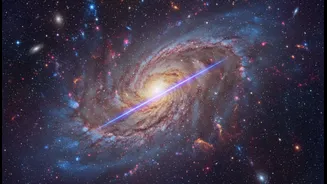
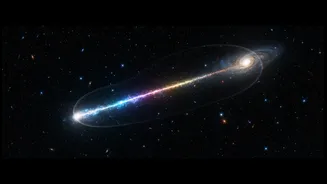
On September 22, 2021, the IceCube observatory detected an incredibly high-energy neutrino, catalogued as IC210922A. Astronomers traced its 11-billion-year journey back to a specific spot in the sky. But when they looked, they didn't find the usual suspect: a blazar, which is an active supermassive black hole spewing out a jet of energy. Instead, they found a distant, dusty galaxy that was faint in visible light but blazed brightly at other wavelengths. Due to its hidden-yet-powerful nature, the team nicknamed it the 'Shadow Blaster'. This galaxy, seen as it was during cosmic noon, appears to be a 'starburst' galaxy, a place of extremely rapid star formation.
A New Kind of Cosmic Engine
The discovery is significant because it suggests a new type of engine for creating high-energy neutrinos. For years, supermassive black holes were considered the primary source. The Shadow Blaster, however, seems to generate these powerful particles through the sheer intensity of its star formation. Within a compact, gas-rich core, cosmic rays—high-energy particles—are accelerated and smash into the surrounding dense gas, a process that can generate neutrinos. This finding suggests that countless other dusty starburst galaxies, previously overlooked, could be major contributors to the background hum of high-energy neutrinos that observatories like IceCube detect. It opens up a new category of objects to study to understand the universe's high-energy processes.
Unlocking Primordial Secrets
By identifying a starburst galaxy as a potent neutrino source, the Shadow Blaster provides a crucial puzzle piece for understanding cosmic noon. It helps explain where the universe's vast number of high-energy cosmic rays come from, a mystery that has persisted for over a century. Since neutrinos point directly back to their origin, each detection from a source like this is a breadcrumb leading back to the cosmic accelerators of the early universe. It allows scientists to probe the physics of environments that are otherwise hidden from view, revealing the mechanisms that fueled galaxy growth and shaped the cosmos we see today. This discovery marks a key step in the era of 'multi-messenger astronomy', where combining data from neutrinos, light, and gravitational waves gives us a much fuller picture of cosmic events.