


The Old Picture: A Chaotic Beginning
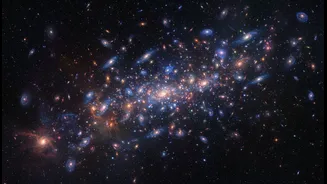
The standard story of the cosmos is one of gradual, painstaking construction. In the aftermath of the Big Bang, matter was spread almost uniformly. Over hundreds of millions of years, gravity pulled this primordial gas into clumps. These clumps grew into small,
irregular, and turbulent protogalaxies. The prevailing theory was that these messy, chaotic systems would then spend billions of years crashing into and merging with each other, slowly and violently settling into the grand, structured galaxies we see today, like the elegant spirals of Andromeda or our own Milky Way. Finding a well-organised galaxy in the early universe was considered highly improbable, like finding a fully-built skyscraper in a construction site that just broke ground.
A Discovery of Surprising Order
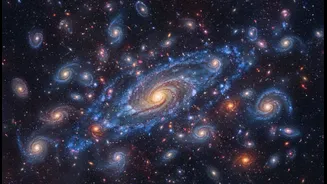
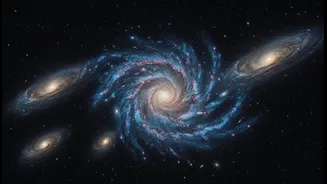
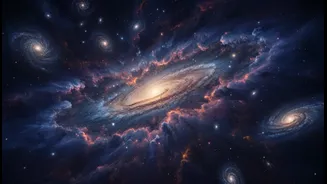
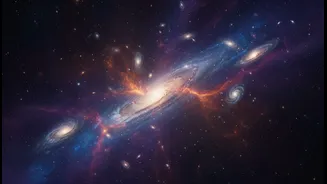
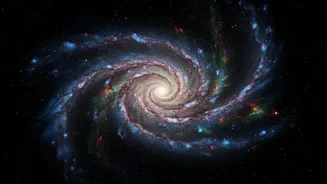
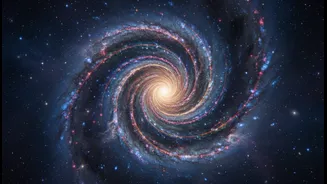
A team of Indian researchers from the Pune-based National Centre for Radio Astrophysics (NCRA-TIFR) has made a discovery that challenges this entire timeline. While analysing data from the James Webb Space Telescope (JWST), PhD student Rashi Jain and her supervisor Professor Yogesh Wadadekar identified a galaxy that simply shouldn’t exist so early. Named Alaknanda, this galaxy is seen as it was just 1.5 billion years after the Big Bang, when the universe was only 10% of its current age. Yet, Alaknanda is not the messy clump astronomers expected. It is a stunningly mature 'grand design' spiral galaxy, with two clear, symmetric arms. It looks remarkably similar to our Milky Way, despite its ancient origins.
How Indian Scientists Spotted Alaknanda
The discovery of Alaknanda highlights the pivotal role of Indian scientists in modern astronomy. Rashi Jain was poring over vast datasets from the JWST, examining details of some 70,000 celestial objects, when she spotted the one-in-a-million anomaly. Alaknanda stood out with its classic spiral structure, complete with clusters of stars like 'beads-on-a-string' along its arms, a feature common in nearby galaxies but unheard of in such a distant one. The team named the galaxy Alaknanda after the Himalayan river; in Hindi, the Milky Way is called 'Mandakini', and the Alaknanda river is its sister headstream. The name thoughtfully connects this distant, ancient galaxy to our own cosmic home. The find was so significant it was published in the leading European journal, Astronomy and Astrophysics.
Rewriting the Rules of Galaxy Formation
So, what does it mean to find a galaxy like Alaknanda so early in cosmic history? It forces a major rethink of our models. The existence of such a large, structured disk just 1.5 billion years after the Big Bang suggests that the processes of galaxy formation could be far more rapid and efficient than previously believed. Alaknanda managed to assemble the mass of 10 billion suns and settle into a stable, rotating disk in what is, cosmically speaking, the blink of an eye. This discovery, along with other recent JWST findings of unexpectedly mature early galaxies, suggests that the 'chaotic youth' phase of the universe may have been shorter or less universal than we thought. It opens up new questions and sends theorists back to the drawing board to figure out the mechanisms that could allow a galaxy to get so organised, so fast.