



Paal Payasam: The Sacred Offering of the South
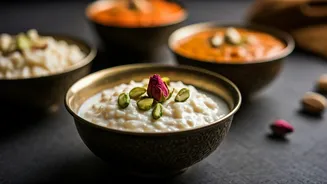
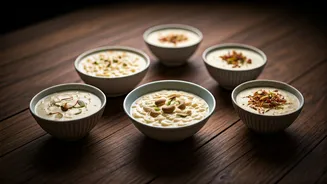
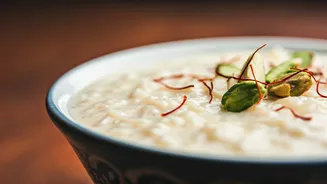
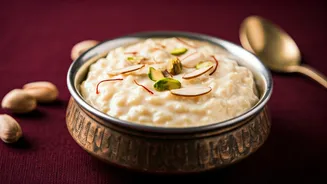
Down South, particularly in Tamil Nadu and Kerala, kheer is known as payasam. Paal Payasam, in its purest form, is a minimalist masterpiece. [10] Made with just milk, rice, and sugar, its magic lies in the slow-cooking process where milk reduces and caramelises,
lending the dessert a naturally rich flavour and a beautiful pinkish hue. [23] Often prepared as 'prasadam' (a divine offering) in temples, its history is ancient, with mentions dating back to the Vedic period. [10, 16] The famed Ambalappuzha Paal Payasam, for instance, is legendary, served without any garnish to let the pure, creamy flavour of the milk and rice shine through. [17, 23] This simplicity is its strength, representing a sweet, auspicious beginning for festivals and celebrations. [10]
Gil-e-Firdaus: The Royal Indulgence from Hyderabad
Translating to 'Clay of Paradise', Gil-e-Firdaus is a Hyderabadi dessert as rich and regal as its name suggests. [11] This festive kheer is a luxurious concoction made with grated bottle gourd (lauki), basmati rice, and sabudana (tapioca pearls), all slow-cooked in thick milk. [7, 12] What makes it truly decadent is the addition of ingredients like condensed milk, khoya, and almond paste, which create a creamy, melt-in-the-mouth texture. [7, 14] It is a staple at Hyderabadi weddings and special occasions, where its delightful consistency and flavour make it a celebrated finale to a grand feast. [11, 12]
Kong Phirin: The Saffron-Scented Gem of Kashmir
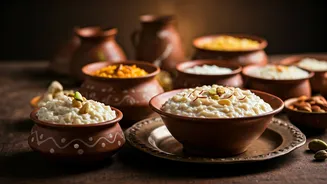
Travel north to the valleys of Kashmir, and you'll find Phirin (or Phirni). The local variant, Kong Phirin, gets its name from 'kong'—the Kashmiri word for saffron. Unlike the ground rice used in North Indian phirni, the Kashmiri version often uses semolina (suji/rava). [29, 34] This gives it a unique, lighter texture. The dessert is a beautiful pale yellow, thanks to the generous infusion of saffron, and it’s traditionally set in earthenware bowls called 'kulhads'. [29, 32] These clay bowls absorb excess moisture, resulting in a thicker, creamier Phirin with an earthy aroma that complements the fragrant saffron and cardamom. [29]
Mangane: The Coastal Delight from Goa
Along the western coast, Goan cuisine offers Mangane, a kheer that stands apart. This traditional dessert is naturally vegan-friendly, using coconut milk instead of dairy. [3, 8] The core ingredients are chana dal (split Bengal gram) and sabudana, which are cooked in creamy coconut milk and sweetened with earthy pyramid jaggery, giving it a deep, caramel-like flavour. [3, 4] Commonly prepared for festivals like Ganesh Chaturthi and other religious functions, Mangane has a comforting, luscious porridge-like consistency. [4, 6] The combination of chana dal with the sweet, tropical notes of coconut and jaggery makes it a uniquely coastal and nourishing treat. [3]
Dehrori: A Festive Treasure from Chhattisgarh
Venture into the heart of India to Chhattisgarh, the 'rice bowl of India', and you'll discover Dehrori. [35] This is not a typical simmered pudding, but a unique and delicious sweet dish often called a 'rice gulab jamun'. [27] It's made from a batter of coarsely ground rice and curd, which is fermented overnight. [27, 30] Small dumplings of this fermented batter are then deep-fried until golden and subsequently soaked in a fragrant sugar syrup. [27, 31] Prepared especially during festivals like Holi and Diwali, Dehrori is a time-intensive but rewarding dessert that showcases a completely different way to celebrate rice in a sweet form. [27]