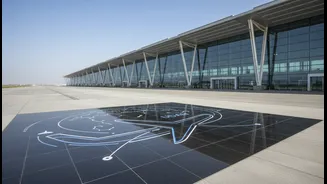









A World-Class Gateway
There is no denying the new terminal at Lokpriya Gopinath Bordoloi International Airport is a monumental achievement. Inaugurated in December 2025 and becoming fully operational in February 2026, the facility is designed to handle over 13 million passengers
annually, a massive jump from the old terminal's capacity. Its design, inspired by local motifs like the Kopou orchid and traditional bamboo craftsmanship, offers a grand welcome to the region. With modern amenities, increased aircraft handling capacity, and digital integration like DigiYatra, the terminal positions Guwahati as a formidable aviation hub, intended to be a crucial link in India's 'Act East Policy' by connecting the Northeast with Southeast Asia. It is, by all accounts, an impressive piece of infrastructure designed for the future.
Flights to Everywhere, but from Where?
An airport, however grand, is only as effective as the network it serves. While Guwahati now boasts enhanced capacity, the bigger question of last-mile air connectivity for the rest of the region remains. The UDAN (Ude Desh ka Aam Nagrik) scheme has made strides, operationalising numerous routes in the Northeast to connect previously unserved towns. However, the sustainability of these routes is a persistent issue. A 2023 audit noted that a significant percentage of awarded UDAN routes nationally failed to commence operations or did not survive beyond the initial three-year subsidy period. For many residents in the smaller towns of Arunachal Pradesh, Nagaland, or Mizoram, reaching Guwahati to catch a connecting flight remains a time-consuming and expensive proposition, assuming a viable route from their local airstrip even exists and operates reliably.
The Bumpy Ride to the Runway
The most significant hurdle that a new airport terminal cannot overcome is the state of ground transport. The Northeast's challenging topography of mountains, dense forests, and powerful rivers makes building and maintaining roads and railway lines a monumental task. While thousands of kilometres of national highways and rural roads have been built or upgraded, progress is often slow and subject to delays. For instance, just 25% of rural roads in the region were paved compared to a national average of 54%, according to one analysis. Similarly, while the railway network is expanding to connect all state capitals—a truly ambitious goal—projects in states like Nagaland, Manipur and Sikkim are still years from completion due to the difficult terrain. This means that for a large portion of the region's population, the journey to the airport can be more arduous than the flight itself, undermining the very convenience air travel is meant to provide.
The Unseen Wires of the Digital Divide
In the 21st century, connectivity is as much about data as it is about transport. Here too, the Northeast faces a significant deficit. The region grapples with insufficient internet infrastructure, leading to what some have called 'digital isolation'. Internet penetration and tele-density in several states, including Assam, are lower than the national average. Difficult terrain and logistical challenges have slowed the rollout of reliable broadband, affecting everything from education and healthcare to business and e-governance. Poor connectivity also leads to higher rates of failure for digital payment transactions, eroding trust and slowing adoption. A gleaming airport terminal with digital check-ins stands in stark contrast to a region where consistent internet access remains a luxury for many, highlighting a disconnect between a modern transport hub and the digital ecosystem it needs to thrive.