






Cosmic Lighthouses: What Are Pulsars?
Imagine a star more massive than our Sun collapsing under its own gravity into a sphere just the size of a city. What you get is a neutron star, an object so dense that a single teaspoon of its material would weigh a billion tonnes on Earth. Pulsars are
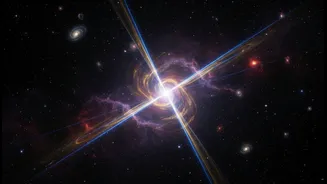
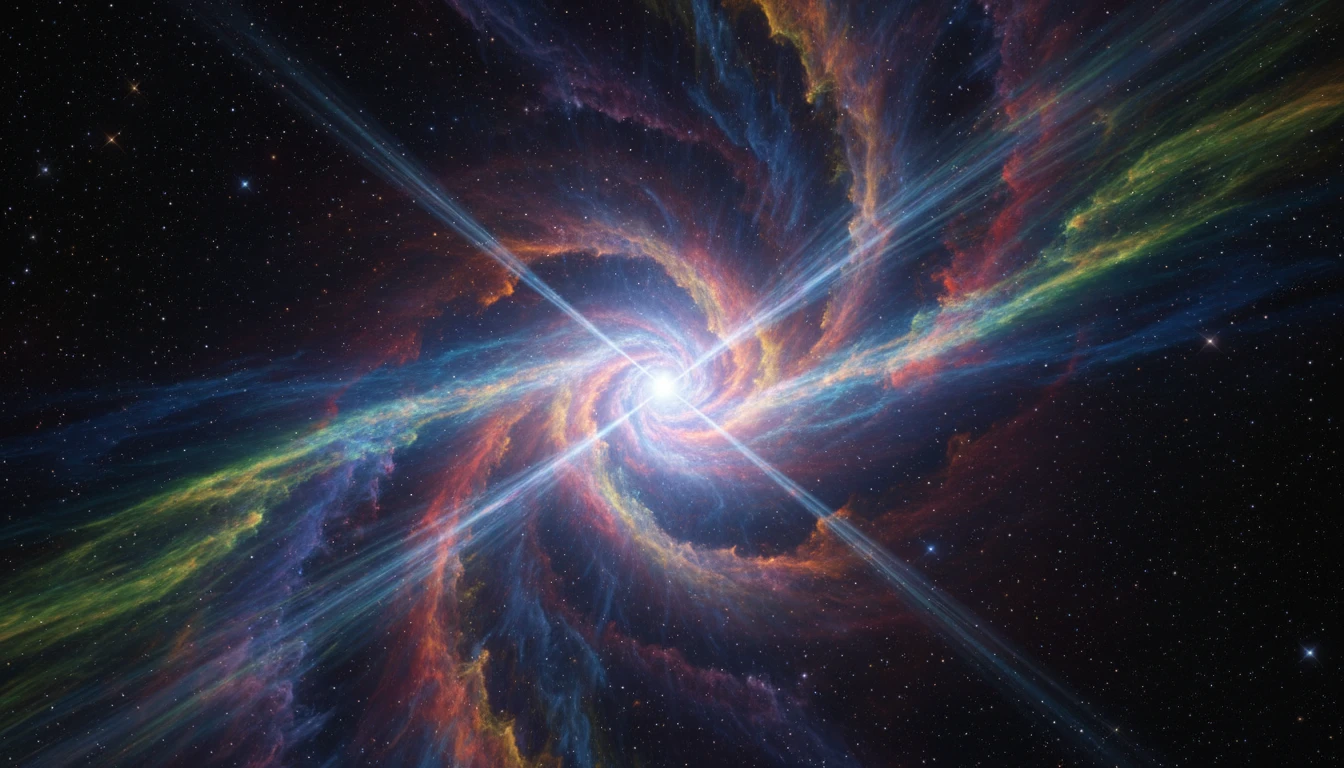
a special kind of neutron star that spin incredibly fast — some hundreds of times per second. This rapid rotation, combined with their immensely powerful magnetic fields, causes them to shoot beams of radiation from their magnetic poles. As the star spins, these beams sweep across the galaxy like a lighthouse, and when one points towards Earth, our telescopes see a regular, repeating pulse of energy. It is this clock-like regularity that makes them such fascinating objects for scientists.
Mapping the Beams
The headline's "Lighthouse Pulsar Map" refers to a conceptual goal more than a single project, achieved through instruments like NASA's Neutron star Interior Composition Explorer (NICER) and the Imaging X-ray Polarimetry Explorer (IXPE). NICER, perched on the International Space Station, can time the arrival of X-rays from pulsars with a precision of under a hundred nanoseconds. This allows scientists to not only detect the pulses but to model the surface of the pulsar itself. In a groundbreaking first, NICER created a surface map of a pulsar named J0030, revealing the location and shape of its 'hot spots' — the regions from which the radiation beams emerge. This is less like drawing a map of stars and more like creating a detailed topographical survey of a distant, alien world.
Rewriting Pulsar Physics
For decades, the textbook model of a pulsar was simple: two hot spots at opposite magnetic poles, just like Earth's North and South poles. But the maps from NICER have shattered this clean picture. The very first surface map of pulsar J0030 showed that its hot spots were not only complex in shape—one appearing like a long crescent—but were all located in its southern hemisphere. This was a complete surprise and suggests that pulsar magnetic fields are far more complicated than the simple two-pole model assumed. This forces physicists to rethink the fundamental mechanisms that govern the interiors and magnetic structures of these incredibly dense objects. It's like discovering lighthouses can have multiple, oddly shaped beams all pointing from one side of the tower.
A Lab for High-Energy Particles
Pulsars are nature's own particle accelerators, flinging particles out at nearly the speed of light. Understanding how they do this is a major goal for high-energy physics. A recent study using NASA's IXPE telescope focused on the 'Lighthouse Nebula' and confirmed a long-held theory. Researchers suspected that the highest-energy particles escape the pulsar's immediate environment by flowing along the galaxy's magnetic field lines, creating long, thin filaments of X-ray light. By measuring the polarization of this light, scientists confirmed that the magnetic field does indeed act as a highway for these escaping particles. This gives us a direct glimpse into how pulsars inject massive amounts of energy into the galaxy, a process that shapes their cosmic neighbourhoods and contributes to the flux of high-energy cosmic rays that constantly bombard Earth.
Beyond the Map: A New Cosmic GPS?
The incredible regularity of pulsar signals has another potential application: navigation. Because their pulses are so predictable, they can be used as cosmic clocks. By timing the signals from a collection of known pulsars, a spacecraft could triangulate its position anywhere in deep space without needing to communicate with Earth. NASA has already successfully tested this concept with its SEXTANT technology demonstration, which used NICER to determine a location in space to within a few miles. While still in its early stages, this pulsar-based GPS could one day guide probes to other stars. The very maps that are rewriting physics could also be the ones that guide humanity's journey further into the cosmos.