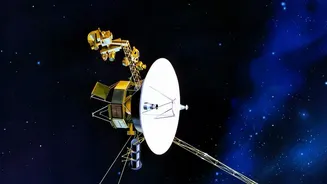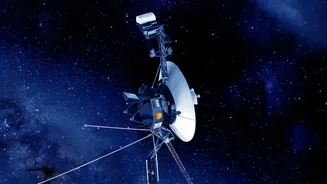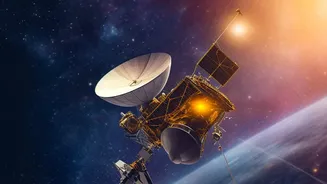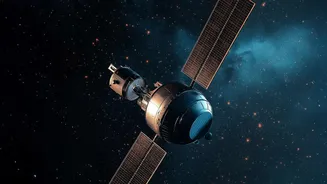




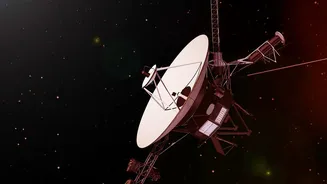
Launched when Jimmy Carter was president, NASA's Voyager 1 is about to hit a milestone that feels like science fiction. It will soon be one light-day from Earth, a lonely outpost reminding us just how far human ingenuity can reach.
What Exactly Is a Light-Day?
It sounds like a unit
of time, but a 'light-day' is a measure of immense distance. It is how far a particle of light travels in a complete 24-hour day. In more down-to-Earth terms, that’s approximately 25.9 billion kilometres (or 16.1 billion miles). To put that into perspective, light from the Sun takes a little over eight minutes to reach us, making our star about 8.3 light-minutes away. Voyager 1's new milestone means it is about 173 times farther from us than our own Sun. On November 18, 2026, the spacecraft will officially cross this threshold, becoming the first object built by humanity to venture so far. The distance is so vast that a radio signal sent from Earth, traveling at the speed of light, will take a full day to reach the probe. A round-trip communication—asking Voyager 1 a question and getting a response—will take 48 hours.
A Journey for the Ages
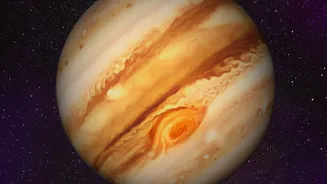
Voyager 1 left Earth on September 5, 1977, on a mission to conduct a 'Grand Tour' of the outer planets. It was launched 16 days after its twin, Voyager 2, but placed on a faster trajectory. Its primary mission was a stunning success. In 1979, it flew past Jupiter, discovering the planet’s faint rings and the shocking existence of active volcanoes on its moon, Io. Then, in November 1980, it reached Saturn, providing unparalleled data on its magnificent ring system and moons. After its flyby of Saturn's moon Titan, its planetary mission was complete. With its trajectory flinging it out of the plane of the solar system, it began its new, extended mission: to travel toward the stars as humanity's farthest explorer. In February 1998, it officially became the most distant human-made object in space, a title it has held ever since.
Entering the Space Between Stars
Perhaps Voyager 1's most significant achievement came in August 2012, when it crossed the 'heliopause'. This is the boundary where the constant stream of particles from our Sun, known as the solar wind, is no longer strong enough to push back the material of interstellar space. By entering this region, Voyager 1 became the first spacecraft to directly sample the medium between the stars. It is now traveling through a near-perfect vacuum, cruising at a steady speed of about 61,000 kilometres per hour. While it has left the Sun's protective bubble, it hasn't quite left the solar system. Scientists estimate it will take another 300 years just to reach the inner edge of the Oort Cloud, a vast, theoretical shell of icy comets still loosely bound by the Sun's gravity.
Still Talking After All These Years
Communicating with a nearly 50nd year old probe across billions of kilometres is a monumental challenge. Voyager 1 was built with 1970s technology; its computers have just 68 kilobytes of memory, and it sends data back to Earth at around 160 bits per second, millions of times slower than a home internet connection. Power comes from three radioisotope thermoelectric generators, which convert heat from decaying plutonium into electricity. With that power supply dwindling by about four watts per year, NASA engineers have been strategically shutting down systems and instruments to prolong its life. Recently, engineers overcame a serious issue where a failed memory chip caused the probe to send back garbled data for months, a fix that required immense creativity and patience. Thanks to these efforts, two science instruments remain operational, studying the interstellar environment. NASA hopes to keep receiving data until at least 2036, when the signal may finally become too faint to detect.