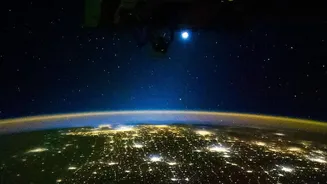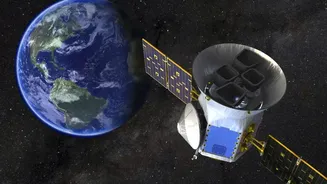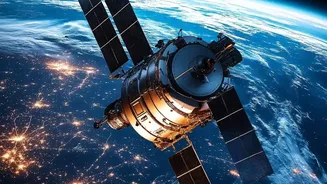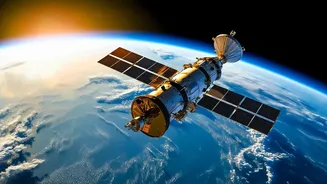








The insatiable demand for artificial intelligence is pushing data centers to their next frontier: Earth's orbit. This move promises vast solar power and efficiency but creates a direct conflict with astronomy, threatening our ability to see the stars.
What is Orbital Computing?
Imagine a data center, with its racks of powerful servers processing information, but instead of a warehouse in Virginia or Mumbai, it is a satellite hurtling through space. This is the core idea behind orbital computing. Companies are now actively developing and launching networks of satellites designed not just for communication or observation, but to function as full-fledged data processing hubs in low Earth orbit (LEO). AI's massive appetite for electricity and cooling is straining terrestrial power grids and water supplies. In space, these constraints vanish. Satellites can access continuous, unfiltered sunlight for power and use the vacuum of space as a giant, free radiator to cool down hardware. Instead of beaming massive amounts of raw data from observational satellites back to Earth—a slow and costly process—orbital data centers can process it on-site. An AI model in orbit could analyze satellite imagery, identify specific events like wildfires or maritime activity, and send only the crucial insights back to the ground, reducing latency from hours to minutes.
The Race to Power AI in Space
The push for orbital computing is being driven by some of the biggest names in technology and a cohort of ambitious startups. Companies like SpaceX, Google, and Amazon's Kuiper are building the foundational infrastructure, while startups such as Starcloud, Axiom Space, and others are pioneering dedicated orbital data center services. The market is transitioning from purely theoretical to operational, with demonstration satellites already in orbit. Starcloud, for instance, launched a satellite in late 2025 equipped with a powerful NVIDIA GPU to train an AI model in space for the first time. The economic case is compelling; by some estimates, the energy cost for computing in space could be up to 15 times lower than on Earth. This has ignited a race to build out what some are calling the next layer of global IT infrastructure, one that exists entirely above the clouds.
Astronomy's Looming Shadow
For astronomers, this new orbital gold rush casts a long shadow. The proliferation of thousands, or even hundreds of thousands, of new satellites poses a fundamental threat to their ability to observe the universe. The problems are twofold: light pollution and radio interference. Satellites, particularly those in large constellations, reflect sunlight, creating bright streaks across long-exposure images taken by ground-based telescopes. It is now almost impossible to take a deep-sky image without it being contaminated by at least one satellite trail, potentially ruining years of research. This impacts everything from the search for Earth-threatening asteroids to the study of distant galaxies.
The Battle for Quiet Skies
Beyond visible light, these satellite networks also crowd the radio spectrum. All satellites use radio waves to transmit information, and their signals can easily overpower the faint cosmic whispers that radio astronomers listen for to understand phenomena like black holes and star formation. Radio-quiet zones, typically located in remote areas, have long protected observatories from ground-based interference, but they offer no defense against signals raining down from a satellite flying overhead. As the number of satellites multiplies, no location on Earth will be truly radio-quiet, threatening to blind a crucial window into the cosmos. Uncontrolled emissions from satellite constellations can bleed into frequency bands that are specifically protected for radio astronomy, rendering them useless.
Searching for a Compromise
The tension between technological ambition and scientific preservation has led to a search for compromise. Astronomical bodies like the International Astronomical Union (IAU) are in active dialogue with satellite operators to find solutions. Companies like SpaceX have experimented with mitigations, such as painting satellites with darker, lesserslective materials and developing dielectric mirror films that scatter sunlight away from Earth. Another key strategy involves flying satellites at lower altitudes (under 600 km), which ensures they are in Earth's shadow for more of the night and thus not illuminated. Furthermore, sharing precise, real_time orbital data allows observatories to schedule their observations to avoid known satellite passes. However, these solutions are not perfect. Some mitigation techniques, like sun visors, have been abandoned because they interfered with other satellite functions, and even with mitigations in place, the sheer number of planned satellites means a significant impact is unavoidable.