


The Junkyard Above Our Heads
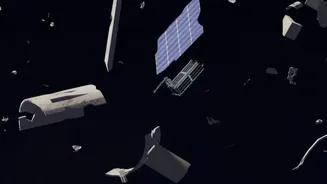
Imagine a highway with no rules, where every abandoned vehicle continues to hurtle along at over 28,000 kilometres per hour. That’s the situation in low-Earth orbit. For decades, we have been launching rockets and satellites, and not everything has come
back down. The result is a cloud of debris comprising everything from defunct satellites and spent rocket stages to tiny flecks of paint and metal fragments from accidental collisions. According to NASA, there are hundreds of thousands of marble-sized objects and millions of smaller pieces that are too small to be tracked. Even a small object can inflict catastrophic damage on an operational satellite or spacecraft, creating even more debris in a chain reaction known as the Kessler Syndrome. This orbital junkyard threatens not only future space exploration but also the global infrastructure that depends on satellites for communication, navigation, and weather forecasting.
Enter the Cosmic Cleanup Crew
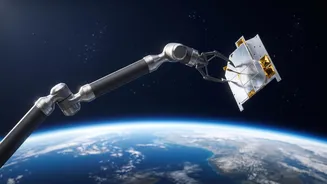
For years, the solution to space debris was simply to try not to create more. But with the existing population of junk posing a growing risk, a more proactive approach is needed. This is where Active Debris Removal, or ADR, comes in. ADR involves sending specialized spacecraft—think of them as cosmic tow trucks—to rendezvous with, capture, and safely deorbit large pieces of debris. The goal is to remove an object from a valuable orbit and guide it to a controlled reentry where it will burn up harmlessly in Earth's atmosphere. This isn't just a theoretical concept; it's an emerging commercial industry, with pioneering companies and space agencies developing the technologies to make our orbits more sustainable.
Magnetic Capture, Claws, and Nets
So how do you catch a dead satellite tumbling through space? The headline’s “magnetic nets” hints at one of the leading ideas: magnetic grappling. Japanese company Astroscale has successfully demonstrated a system called ELSA-d, which uses a magnetic docking plate. The idea is for future satellites to be built with a compatible plate. When the satellite reaches the end of its life, a “servicer” spacecraft can easily lock on magnetically, then drag the defunct satellite down to burn up in the atmosphere. It’s less of a “net” and more of a high-tech magnetic handshake. Other methods are also being developed to tackle older debris that wasn’t prepared for capture. The European Space Agency (ESA) is backing a mission from Swiss startup ClearSpace, which will use a large “space claw” with four robotic arms to grab and deorbit its target. Earlier missions, like the UK-led RemoveDEBRIS project, have also successfully tested other concepts in orbit, including firing a giant net to ensnare a target and even a harpoon to spear it.
Pioneers of the Orbital Sweep
Two names currently dominate the race to commercialize space cleanup: Astroscale and ClearSpace. Astroscale has already achieved significant milestones with its ELSA-d mission, which proved that its magnetic capture technology works in space during tests in 2021 and 2022. The company is now developing its next-generation ELSA-M servicer, designed to capture multiple satellites in a single mission, with a launch planned for 2026. On the other side of the globe, ClearSpace is working closely with ESA on its ClearSpace-1 mission. Initially slated for 2026, the ambitious mission aims to capture and remove an old piece of a European rocket, and later a defunct ESA satellite, using its robotic arms. The mission, now planned for 2028, will be the first of its kind to remove an existing, unprepared piece of debris, demonstrating a crucial capability for cleaning up legacy junk.
A High-Stakes Tidy-Up
The drive to clean up space isn't just about being tidy; it's about protecting a multi-billion dollar economy and ensuring access to space for future generations. The mega-constellations being deployed by companies like SpaceX and OneWeb involve thousands of satellites, making the orbital environment more congested than ever. A single major collision could have widespread consequences. Debris removal is therefore becoming a critical service for satellite operators, insurance companies, and governments. By proving these technologies work, companies like Astroscale and ClearSpace are not just removing junk; they are creating a new market for in-orbit services that will be essential for the long-term sustainability of all space activities.