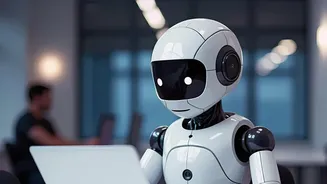







Beyond the Replacement Myth
For years, the conversation around artificial intelligence has been dominated by a single, terrifying question: 'Will a robot take my job?' This narrative of mass unemployment, however, misses the central point, according to extensive analysis from research
firm Gartner. Their projections consistently argue that AI's primary role in the workplace of 2030 won't be universal job replacement. Instead, it will be a powerful force for job transformation and augmentation. Gartner's research suggests that while some jobs with routine, repetitive tasks will indeed be automated, AI is projected to be a net job creator. The focus shouldn't be on a binary of elimination versus retention, but on evolution. The real story is about how existing roles will be reshaped and what new roles will be born.
The Rise of the AI-Augmented Worker
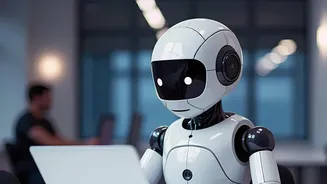
The key concept to grasp is 'augmentation'. Think of AI not as a replacement for a human worker, but as a powerful assistant or tool. An AI-augmented employee is one who uses artificial intelligence to perform their job better, faster, and more efficiently. For instance, a marketing manager might use AI to analyze vast datasets to identify consumer trends in seconds, a task that would have previously taken a team weeks. A software developer might use an AI coding assistant to write boilerplate code, freeing them up to focus on complex problem-solving and architecture. This collaboration between human and machine allows the human to focus on uniquely human skills: strategic thinking, creativity, emotional intelligence, and complex decision-making. Gartner refers to this as a 'human-in-the-loop' model, where technology handles the grunt work, elevating the strategic value of the human employee.
Jobs Created, Not Just Changed
While role transformation is the main event, Gartner also predicts the creation of entirely new job categories. We are already seeing the emergence of roles that were unheard of a decade ago, such as AI ethicists, prompt engineers, and AI model trainers. By 2030, this trend is expected to accelerate. There will be a growing need for professionals who can develop, manage, and govern AI systems. This includes not just the highly technical roles, but also business-focused positions like 'AI business development managers' or 'machine learning operations (MLOps) managers'. For a country like India, with its vast technology and services sectors, this represents a significant opportunity. The challenge lies in pivoting the workforce from legacy roles to these new, in-demand specializations.
The Critical Skill Shift
This evolution of jobs naturally leads to a required evolution in skills. The workforce of 2030 will need a blend of technical and soft skills to thrive in an AI-powered environment. On the technical side, an understanding of data literacy, basic AI principles, and how to interact with AI tools will become as fundamental as computer literacy is today. However, the most durable skills will be the ones that AI cannot easily replicate. These include critical thinking, complex problem-solving, creativity, leadership, and collaboration. As AI automates the predictable parts of a job, the value of human intuition and ingenuity will only increase. Professionals who can ask the right questions, interpret AI-driven insights, and communicate them effectively will be indispensable.