






Beyond the Gaze of the Sun
The Kuiper Belt is a vast, doughnut-shaped region at the edge of our solar system, populated by thousands of miniature icy worlds that formed some 4.5 billion years ago. These distant objects, so far from the Sun's warmth, were long presumed to be inert
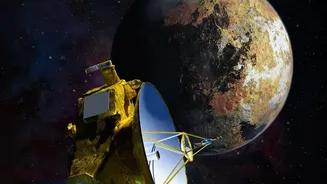
and geologically dead—ancient relics preserved in a deep freeze. Worlds like Pluto, and its even more distant cousins Eris and Makemake, were seen as little more than cold, inactive rocks. The 2015 flyby of Pluto by NASA's New Horizons spacecraft began to shatter that image, revealing a world with towering mountains of water ice, vast nitrogen glaciers, and signs of active geological processes. This discovery opened the door to a radical new question: if Pluto is active, what about the other worlds lurking in the cold, dark expanse?
Signs of Hot Times in Cool Places
Recent studies have now turned the spotlight on two other large dwarf planets: Eris and Makemake. Using the powerful James Webb Space Telescope (JWST), scientists analysed the specific chemical fingerprint of methane ice on their surfaces. They found tell-tale signs that this methane was not primordial—left over from the solar system's birth—but was instead the product of thermal processes deep within the planets' rocky cores. According to Christopher Glein, a planetary scientist at the Southwest Research Institute, this suggests hydrothermal or metamorphic activity, essentially indicating warm, or even hot, geochemistry. This discovery points to the idea that these dwarf planets may have warm interiors capable of driving geological change on the surface, a process known as cryovolcanism.
Ice Volcanoes and Liquid Nitrogen
Cryovolcanism is the eruption of volatile materials like water, ammonia, or nitrogen, which are liquid deep beneath the surface but freeze solid once they reach the extreme cold of space. The evidence on Eris and Makemake suggests that internal heat, likely from the decay of radioactive elements in their cores, could be sufficient to create subsurface liquid and send it to the surface. This upends the old assumption that only moons orbiting giant planets could generate enough internal heat through gravitational tides to be active. Closer to home, a fresh analysis of New Horizons data from Pluto, published in August 2026, provided the first evidence of recently flowing liquid on its surface. Scientists believe liquid nitrogen may be melting at the base of Pluto's massive Sputnik Planitia glacier and welling up through cracks, staining the surface in a process similar to how meltwater darkens ice on Earth.
A More Dynamic Solar System
These findings are transforming our understanding of planetary evolution. It appears that even small, isolated worlds in the farthest reaches of our solar system can generate and retain enough heat to power geological activity over billions of years. The discovery of massive landslides on Pluto, also identified in a re-examination of New Horizons images, further cements the dwarf planet's status as a dynamic world. These ground movements, some travelling for miles across crater walls, could be triggered by tectonic activity or meteoroid impacts, showing how the surface is constantly being reshaped. The clues from Pluto, Eris, and Makemake suggest that the Kuiper Belt is not a planetary graveyard but a region filled with active, complex worlds, some of which could even harbour subsurface oceans.