



A Radical Departure from Landing Legs
For years, the world has watched in awe as SpaceX’s Falcon 9 boosters autonomously returned to Earth, landing upright on their own deployable legs. It’s a marvel of modern engineering that has become almost routine. But for its next-generation Starship,
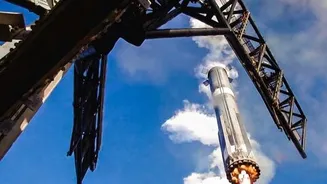
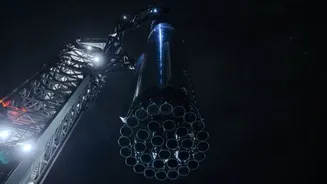
the most powerful rocket ever built, SpaceX is rewriting the rulebook entirely. The strategy involves eliminating landing legs on the Super Heavy booster and instead catching the massive vehicle with a mechanism on the launch tower itself. Nicknamed 'Mechazilla', this system consists of two large, movable arms—often called 'chopsticks'—that are designed to close around the descending booster and lift it back onto the launch mount. The concept is so ambitious that it seems pulled from a movie, but it is central to the company’s business model for deep space exploration.
How the 'Chopsticks' Work
The process is a high-stakes mechanical ballet. After separating from the upper stage, the Super Heavy booster performs a series of engine burns to flip around and fly back to the launch site. As it approaches the tower, it uses its grid fins to steer and its engines for a final braking burn, slowing it to a near-hover beside the tower. This is where the 'chopsticks' come into play. These arms, which also serve to stack the rocket before launch, extend and position themselves to intercept the booster. They are designed to securely grip the booster at reinforced 'hard points' near its top, just below the grid fins. The arms then absorb the final motion and place the booster back on the launch mount, ready for inspection, refuelling, and its next flight. SpaceX successfully demonstrated this feat for the first time on October 13, 2024, during Starship's fifth test flight, catching the returning booster in a flawless manoeuvre.
The Business Case: Speed and Mass
The primary drivers for this complex system are simple: saving weight and saving time. Landing legs, especially those strong enough to support a vehicle as massive as the Super Heavy booster, are incredibly heavy. By removing them, SpaceX frees up mass that can be reallocated to fuel or payload, directly increasing the rocket's capability and efficiency. Every kilogram saved on the rocket's structure is a kilogram that can be added to the payload it carries to orbit. But the even bigger advantage is the potential for rapid reusability. Catching the booster directly on the launch tower eliminates the time-consuming logistics of recovering it from a droneship at sea, transporting it back to port, and then moving it to the launch pad. The 'catch and restack' method could theoretically allow for multiple launches in a single day, a cadence more akin to airline operations than traditional rocketry. This speed is critical for SpaceX’s long-term goals, such as building a self-sustaining city on Mars, which would require an unprecedented frequency of launches.
Next Steps and Remaining Challenges
While SpaceX has successfully caught the Super Heavy booster multiple times since its first achievement in late 2024, the process is still being refined. Several subsequent flights have opted for water landings in the Gulf of Mexico as engineers test other aspects of the flight profile. The next major challenge is to apply the same catch strategy to the Starship upper stage, the vehicle designed to carry crew and cargo. To date, no Starship upper stage has been caught; they have all ended their missions with a splashdown at sea. However, one ship did survive its reentry and ocean landing in July 2026, providing valuable data for future recovery attempts. Elon Musk has indicated that an attempt to catch the upper stage with the tower arms could happen on an upcoming flight, which would mark the first full recovery of the entire orbital launch system. Proving this capability is a critical step before the system can be considered truly and rapidly reusable.