



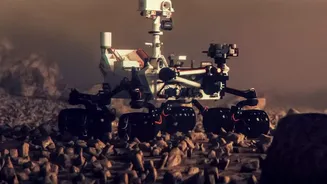
The Case for the Machines
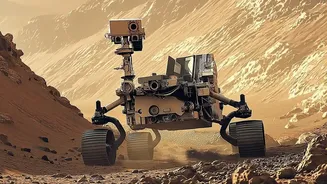
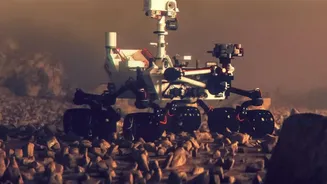
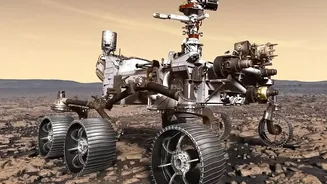
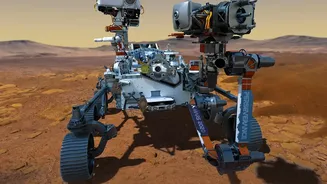
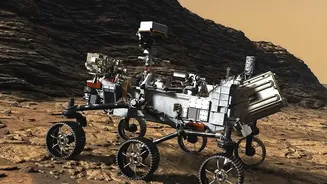
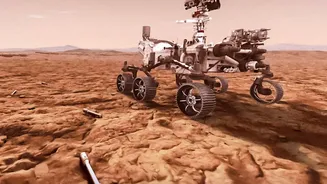
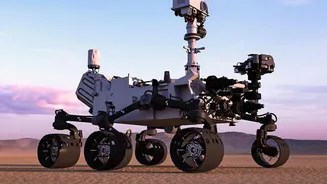
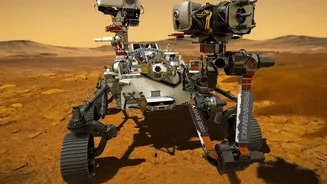
The argument for robotic exploration is built on practicality and efficiency. Sending robots is vastly cheaper and safer than sending astronauts. A crewed mission to Mars could cost upwards of $100 billion, while robotic missions like the Perseverance
rover cost a fraction of that, around $2.7 billion. This is because robots don't need life support, food, water, or a return ticket. They can endure the harsh Martian environment—extreme temperatures, a thin atmosphere, and intense radiation—for years without complaint. In fact, many rovers have long outlasted their planned mission durations, continuously sending back valuable data. Modern autonomous instruments, powered by AI, allow rovers to navigate hazardous terrain, identify scientifically interesting targets, and conduct analysis without real-time human control, overcoming the significant communication delays between Earth and Mars.
The Limits of Remote Control
Despite their growing sophistication, robots have significant limitations. Their most glaring weakness is speed. A Mars rover moves at a crawl, covering in years what a human could traverse in days. The Curiosity rover's maximum speed is just 0.14 kilometers per hour. Scientific tasks that would take a human geologist minutes, like digging a small trench, can take a robotic probe months of painstaking effort. Furthermore, robots lack the intuition and adaptability of a human explorer. They follow programmed instructions and, while their AI can make some decisions, they cannot truly improvise or recognize the unexpected significance of a discovery in the way a trained scientist can. This means that while robots are excellent data collectors, they are slow and methodical explorers, potentially missing subtle clues a human would spot instantly.
The Irreplaceable Human Mind
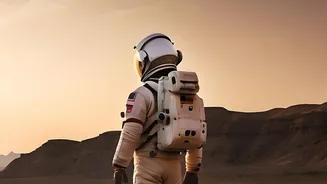
Proponents of crewed missions argue that true exploration requires human presence. A human geologist on Mars could accomplish more in a week than a rover could in a year. Humans possess an unmatched ability for complex problem-solving, real-time decision-making, and situational awareness. They can react to unforeseen circumstances, repair equipment, and apply their senses and experience to interpret a landscape in a holistic way that a robot cannot. This is particularly crucial in the search for life, where finding and identifying fossilized microbes would likely require breaking open countless rocks and making intuitive judgments about where to look—a task ill-suited for a slow-moving, remote-controlled robot. The adaptability of a human crew is seen as the key to accelerating the pace of discovery and making the conceptual leaps that lead to scientific breakthroughs.
The Ultimate Cost and Risk
The dream of sending humans to Mars comes with staggering risks and an astronomical price tag. A mission could last up to three years, requiring massive spacecraft to carry life support systems, food, and water. The human body is not built for deep space; astronauts would face constant threats from cosmic radiation and the debilitating health effects of prolonged microgravity, such as muscle and bone loss. The psychological strain of isolation and the immense communication lag with Earth—up to 24 minutes one-way—also present major challenges. Beyond the human cost, the financial investment is immense, with some estimates for a human Mars program reaching half a trillion dollars. This has led many to argue that dozens of advanced robotic missions could be funded for the cost of a single human expedition.
A Symbiotic Future: Not 'Versus,' But 'Together'
Increasingly, the debate is shifting from a 'robots versus humans' framework to a more integrated strategy. The modern consensus is that robots are not just an alternative to human exploration but an essential precursor and partner. Robotic missions are seen as the advance scouts, mapping terrain, identifying resources, analyzing potential landing sites, and caching scientifically valuable samples for future human crews to retrieve. This approach, often referred to as a 'pro-bot, pro-human' strategy, leverages the strengths of both. Robots can perform the initial high-risk, long-duration reconnaissance, making eventual human missions safer, more targeted, and vastly more productive. Future exploration will likely involve swarms of collaborative robots, drones, and landers working in concert with human crews, creating a powerful hybrid model for unlocking the secrets of the Red Planet.