
A Lion's Roar Across the Cosmos
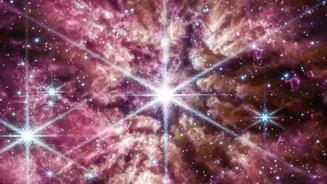
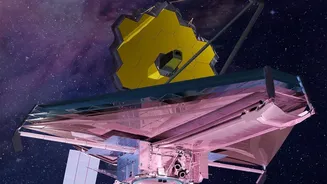
The latest subject of Webb's powerful gaze is NGC 2392, a celestial object nicknamed the Lion Nebula for its uncanny resemblance to a lion's head, complete with a flowing mane. While the Hubble Space Telescope gave us our first look at its striking shape
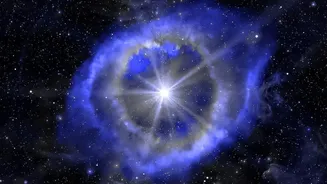
years ago, Webb’s infrared eyes have pierced through the cosmic dust and gas to reveal the scene in breathtaking new detail. At the center of it all, looking like a bright button nose, is the cause of this magnificent structure: the searingly hot remnant of a star that has shed its outer layers. This stellar core, known as a white dwarf, is now flooding its surroundings with radiation, sculpting the gas and dust it once cast off.
The Final Act of a Sun-Like Star
Unlike the universe's most massive stars that go out in cataclysmic supernova explosions, most stars, including our own sun, have a quieter but equally dramatic end. When a lower-mass star exhausts the nuclear fuel in its core, it becomes unstable. It pulsates, shedding its outer layers into space over thousands of years. These expanding shells of gas and dust form what astronomers call a planetary nebula—not because it has anything to do with planets, but because their often-round shapes resembled planets to early astronomers using less powerful telescopes. Left behind is the extremely hot and dense core, the white dwarf, which illuminates the outbound material like a cosmic lightbulb.
What Webb's New View Reveals
Webb's observations of the Lion Nebula are giving scientists a front-row seat to this transformation. Its infrared instruments, NIRCam and MIRI, can see features previously hidden from view. The images highlight dense clumps of dust that have somehow survived the intense radiation from the central star. These clumps form the fiery 'mane' of the lion. They act like shields, protecting trails of material behind them and creating the comet-like tails that are a signature of the nebula. Meanwhile, a bubble of ionized gas expanding from the white dwarf—forming the lion's 'face'—is actively destroying dust in its path. Webb's imagery essentially freezes this dynamic process in time, showing a complex interplay of creation and destruction.
Cosmic Recycling and Our Own Origins
These images are more than just beautiful astronomical portraits; they are snapshots of cosmic recycling in action. The gas and dust expelled by dying stars like the one in the Lion Nebula are rich with heavier elements forged inside the star during its lifetime. This material is blasted into the interstellar medium, the space between stars. Over millions or billions of years, this enriched material will cool, clump together, and eventually form the building blocks for new generations of stars, planets, and, just maybe, life. Studying how this dying star is transforming its environment helps us understand the life cycle of the universe and, ultimately, where the ingredients for our own solar system came from.