



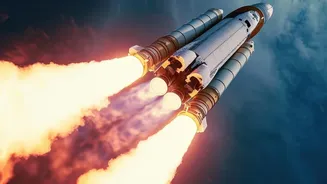
The Lifeboat in the Sky
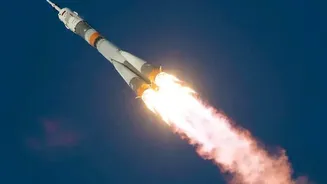
When launching humans into space, nothing is more important than their safety. The most dangerous part of any space mission is the launch itself, when the rocket is a controlled explosion pushing against gravity. If anything goes wrong with the launch vehicle,
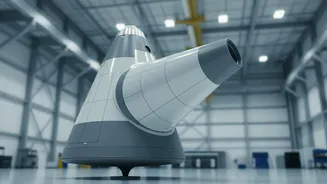
the astronauts need a reliable way to get away instantly. This is the job of the Crew Escape System (CES). Think of it as a highly advanced ejection seat, but for an entire space capsule. The CES is a set of powerful, quick-acting solid-fuel motors attached to the top of the crew module. In a fraction of a second, it can detect a failure, fire its motors, and pull the astronauts safely away from a malfunctioning rocket. This system must work flawlessly, as it is the last line of defence for the crew.
A Trial by Fire at High Altitude
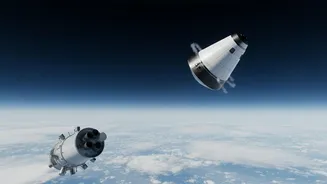
The recent high-altitude abort test was designed to simulate one of the most challenging failure scenarios. A test vehicle, essentially a rocket designed for these trials, carried a full-scale, uncrewed Gaganyaan crew module to a specific altitude. This test specifically targeted the moment of maximum aerodynamic pressure, or 'Max Q', a critical point where the structural stress on the rocket is at its peak during ascent. At this predetermined point, the abort was deliberately triggered. The Crew Escape System's motors ignited with immense force, pulling the crew module away from the test rocket at high acceleration. The goal was to prove that the system could not only separate the capsule cleanly but also steer it onto a safe trajectory, away from the failing launch vehicle.
A Flawless Escape and Recovery
The test was a resounding success. After the powerful motors of the escape system pulled the crew module clear, it was jettisoned as planned. The capsule then followed its programmed descent path. A sequence of parachutes, starting with smaller drogue chutes to stabilize the module and followed by the large main parachutes, deployed perfectly to slow the capsule's descent. The mission ended with a gentle splashdown in the Bay of Bengal, where recovery teams from the Indian Navy were on standby to retrieve the capsule. Every phase of the test, from the high-speed abort to the final recovery, was executed as planned, providing ISRO with invaluable data and a huge confidence boost. This success validates the design and performance of one of Gaganyaan's most critical safety components.
The Road Ahead for Gaganyaan
This successful high-altitude test is one of several rigorous trials ISRO is conducting to 'human-rate' its launch vehicle, the HLVM3. The human-rating process involves exhaustive testing of every component to ensure it meets the highest safety and reliability standards for carrying astronauts. Before this, ISRO had already conducted a Pad Abort Test in 2018, which simulated an emergency on the launch pad itself. The Gaganyaan program includes a series of such test flights, including uncrewed missions, before the final crewed flight. According to recent updates, the first uncrewed Gaganyaan mission is targeted for late 2026. Each successful test, like this high-altitude abort validation, brings India one step closer to joining the elite club of nations capable of independent human spaceflight.