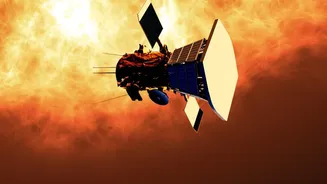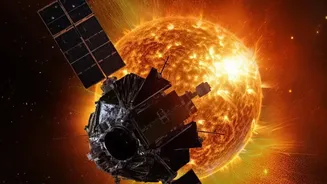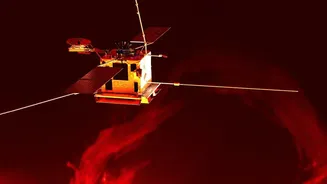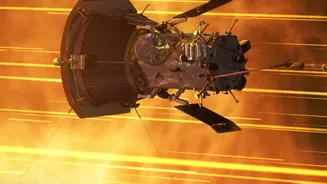

For the first time, scientists are combining observations from India's Aditya-L1 and Europe's Proba-3 missions, creating a powerful new way to study the sun's violent eruptions right from their source. This collaboration marks a new chapter in solar physics.
Two Missions, One Unprecedented View
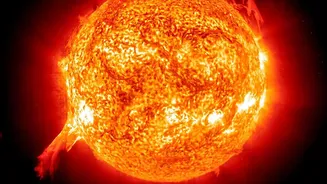
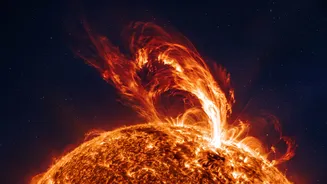
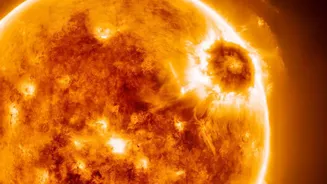
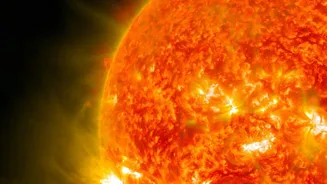
Imagine trying to understand a firework by only seeing the final burst of light. You would miss crucial details about its launch and ascent. For decades, scientists faced a similar problem when studying the sun. They could see the explosive aftermath of solar eruptions, known as Coronal Mass Ejections (CMEs), but struggled to observe their birth. This is now changing, thanks to a landmark collaboration between the Indian Space Research Organisation (ISRO) and the European Space Agency (ESA). By pairing India's Aditya-L1 solar observatory with ESA's Proba-3, researchers are getting a complete, stereoscopic view of these powerful events. Recent joint observations have already provided deeper insights into CME evolution than was ever possible with a single spacecraft.
Aditya-L1: India’s Guardian in Space
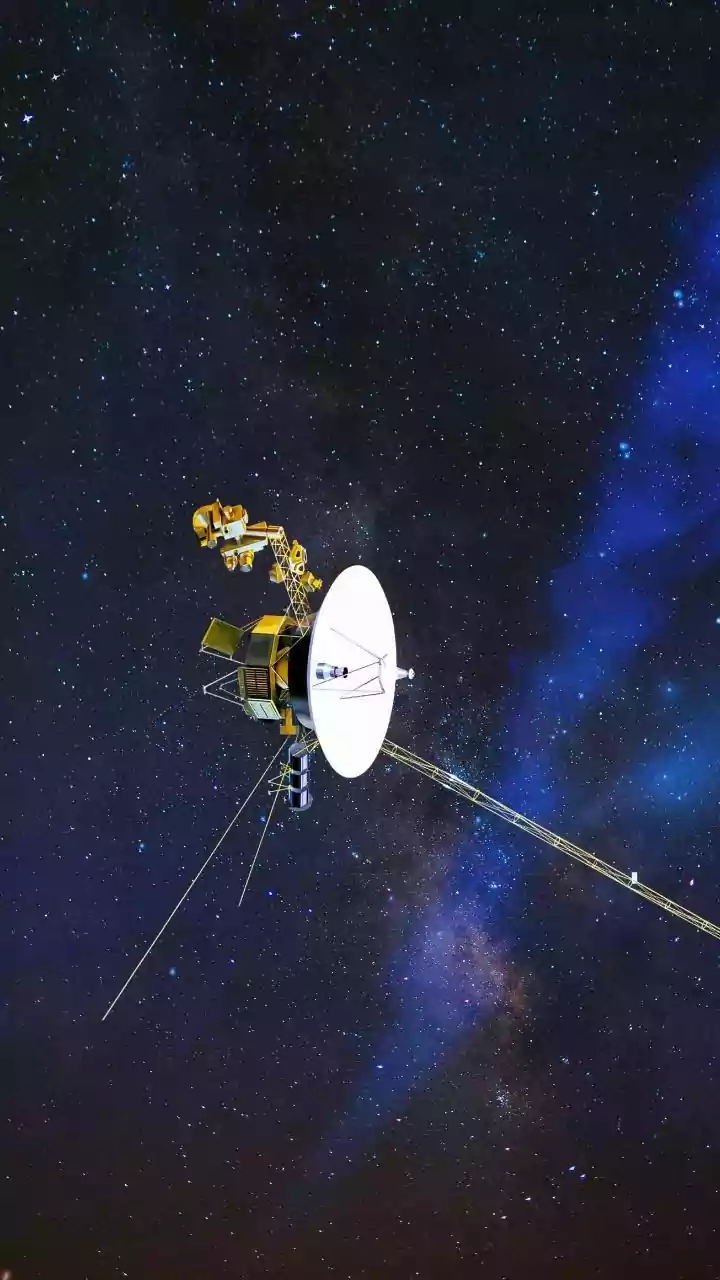
Launched in September 2023, Aditya-L1 is India's first dedicated mission to study the sun. It is strategically positioned at Lagrange Point 1 (L1), a stable gravitational spot 1.5 million kilometres from Earth, which allows it an uninterrupted, 24/7 view of our star. One of its key instruments, the Visible Emission Line Coronagraph (VELC), developed by the Indian Institute of Astrophysics, is a master at studying the sun’s outer atmosphere, the corona. VELC doesn't just take pictures; it performs spectroscopy, which measures how the motion of solar material shifts the light it emits. This allows scientists to calculate the speed and direction of CMEs as they travel away from the sun, providing a crucial third dimension to what other telescopes can see.
Proba-3: Europe’s Artificial Eclipse
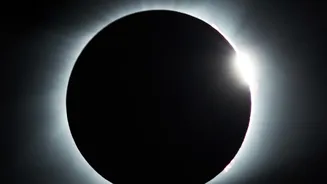
The ESA's Proba-3 mission, launched by an ISRO PSLV rocket in December 2024, is a feat of engineering. It consists of two satellites flying in perfect formation, just 150 metres apart, to create an artificial solar eclipse in space. One satellite acts as an 'occulter', blocking the blindingly bright surface of the sun, while the other uses its coronagraph, ASPIICS, to capture stunningly detailed images of the faint, super-hot inner corona—a region notoriously difficult to observe. This innovative setup allows Proba-3 to watch the very beginning of a solar burst, revealing how CMEs form and accelerate in their first moments. It provides the 'close-up' view that perfectly complements Aditya-L1's broader perspective.
The Power of Teamwork
The joint study, led by researchers from the Indian Institute of Astrophysics in Bengaluru, combines VELC's spectroscopic data with ASPIICS's high_resolution images. This synergy is powerful: Proba_3's instrument captures the shape and structure of a CME as it leaves the sun, while Aditya_L1's instrument measures the speed and direction of the material within that structure. For the first time, scientists have jointly analysed the same CMEs—two events from September 2025—to measure their mass, density, and energy with unprecedented accuracy. The findings, published in the journal 'Astronomy & Astrophysics,' confirm that combining these two different observational methods gives a more complete and cross_checked view of how solar eruptions begin and grow.
Why This Matters for Earth
This research is not just academic. CMEs are the primary drivers of space weather. When a massive burst of charged particles is aimed at Earth, it can trigger geomagnetic storms that disrupt satellite operations, damage power grids, and interfere with GPS and communication networks. Understanding how a CME evolves right from its source is the key to improving our ability to predict its trajectory and potential impact. By knowing a CME's initial speed, mass, and energy, forecast models become far more reliable. This India–Europe collaboration provides exactly that foundational data, moving us closer to a future where we can better protect our critical infrastructure from the sun's powerful outbursts.