

A Rapidly Growing Family
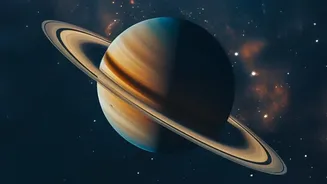
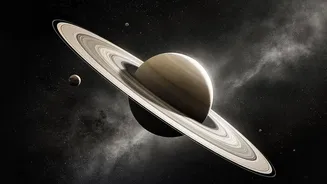
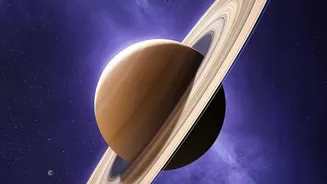
Not long ago, textbooks listed Saturn with around 83 moons. As of mid-2026, that number has skyrocketed to over 290, firmly establishing it as the planet with the most known satellites in our solar system. This surge isn't because new moons have suddenly
appeared, but because our ability to see them has dramatically improved. The vast majority of these recent discoveries are what astronomers call "irregular" moons. Unlike the large, spherical moons like Titan or Enceladus that formed alongside Saturn, these are small, potato-shaped objects, often just a few kilometres across. They tend to have large, tilted, and often backward (retrograde) orbits, suggesting they were once free-floating asteroids or comets that were captured by Saturn's immense gravity long ago.
The Challenge of Finding Tiny Moons
Finding these tiny, distant moons is a monumental task. They are incredibly faint because of their small size and vast distance from Earth. From our perspective, they are like trying to spot a piece of coal against the black of space from over a billion kilometres away. Making matters more difficult, these objects are constantly moving. A single, long-exposure photograph would just show a faint streak, easily lost in the background noise of space. For decades, this limited discoveries to larger moons or those that happened to pass close to a visiting spacecraft like Cassini. The boundary for new discoveries lay in finding a way to track these faint, moving targets over time.
New Eyes on the Sky: The Shift-and-Stack Method
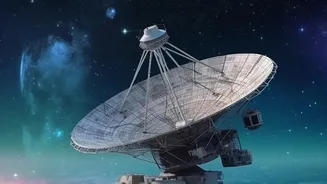
The breakthrough that led to the discovery of over a hundred new moons is a clever data-processing technique called "shift-and-stack". Instead of taking one long-exposure image, astronomers take a series of shorter ones. They then use computers to calculate the predicted path of a potential moon across these frames. The software digitally 'shifts' each image to align the moving object, so it appears in the same spot in every frame. When these shifted images are 'stacked' or combined, the faint light from the moon adds up, making it pop out from the background noise. This method allows astronomers to confirm the existence of objects that are far too faint to be seen in any single image. A team led by Edward Ashton has used this technique with telescopes like the Canada-France-Hawaii Telescope to identify vast numbers of these previously hidden worlds.
What Do These New Moons Tell Us?
Finding these small, irregular moons is more than just a numbers game. Their orbits and groupings provide crucial clues about the history of the Saturnian system and the early solar system itself. Scientists believe many of these moons are fragments from ancient collisions. For example, a larger captured moon might have been smashed apart by another object, creating a family of smaller moons that share a similar orbital path. By studying these clusters, astronomers can piece together the violent history of the outer solar system. The sheer number and diversity of these moons suggest a chaotic past filled with captures and collisions. As observation techniques continue to improve, it's almost certain that the official count will continue to climb, revealing an even more complex and fascinating history orbiting the ringed giant.