





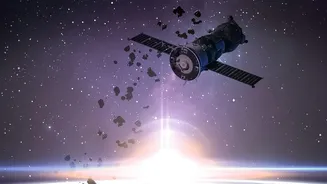
A Junkyard in the Stars
Imagine a highway where every car crash, every lost hubcap, and every dropped bolt continues to circle the Earth at over 17,000 miles per hour. That's the reality in Low Earth Orbit (LEO). Decades of space activity have left a legacy of defunct satellites,
spent rocket stages, and fragments from explosions and collisions. There are an estimated 100 million pieces of debris already circling our planet, ranging from paint flecks to bus-sized rocket bodies. Even a small object can cause catastrophic damage to a functional satellite, disrupting services we rely on daily, like GPS, weather forecasting, and communications. This growing cloud of high-velocity junk poses a serious risk, threatening a scenario known as the Kessler Syndrome, where collisions create more debris, leading to a cascade that could render parts of orbit unusable.
The Challenge of a Cosmic Catch
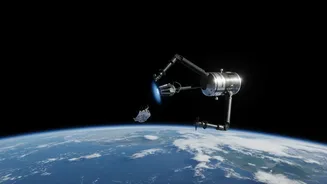
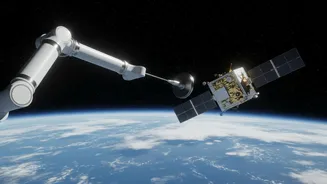
Cleaning up this mess isn't as simple as sending up a garbage truck. The targets are not cooperative; they are often tumbling uncontrollably and moving at incredible speeds. Traditional capture methods, like nets or robotic arms, face challenges when dealing with objects that are spinning unpredictably. A physical grab could impart even more spin, making the object harder to control or even causing it to break apart, creating yet more debris. This is where magnetic capture offers a more elegant, touch-free solution. Several companies and space agencies, including Japan's Astroscale, are pioneering this approach. The concept relies on a simple principle but requires sophisticated engineering to execute.
How Magnetic Capture Works
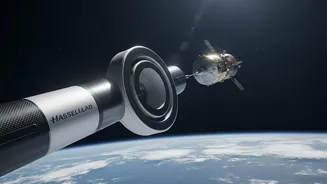
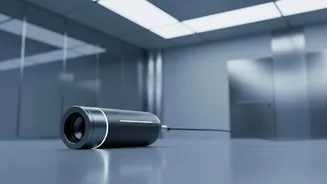
The magnetic capture system works a bit like a high-tech tow hook. A specialized 'servicer' spacecraft is launched to rendezvous with a piece of debris. The key, however, is that this system works best with future satellites. For it to function, the target satellite must be prepared ahead of time by being fitted with a ferromagnetic docking plate before its own launch. Once the servicer approaches the defunct satellite, it uses powerful electromagnets to create a strong magnetic field. This allows it to latch onto the docking plate without making physical contact, synchronizing its rotation with the tumbling object before establishing a secure magnetic connection. Astroscale's ELSA-d mission successfully demonstrated this very principle, proving it could repeatedly capture a test satellite equipped with a docking plate.
The Tether: A High-Tech Leash
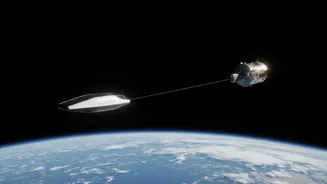
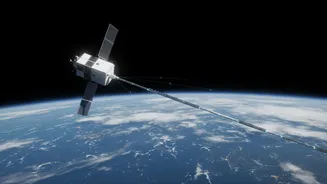
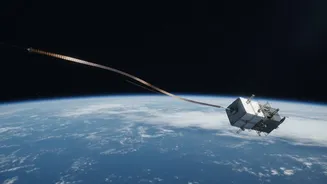
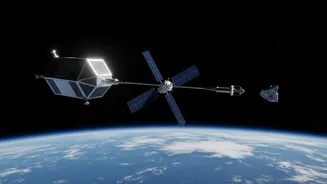
Once the target is magnetically secured, the next step is to get it out of orbit. This is where tethers come into play. A tether is essentially a long, incredibly strong cable. In some concepts, the servicer uses a simple momentum-exchange tether to essentially swing the captured debris and release it into a lower orbit, initiating its fiery reentry into Earth's atmosphere where it can safely burn up. Another, more advanced concept is the electrodynamic tether. This type of conductive tether interacts with the Earth's magnetic field as it moves. By passing an electrical current through it (generated by solar panels), the tether can generate a force, or drag, that slows the captured object down without using any propellant. This propellant-free braking is highly efficient, allowing a single servicer to potentially deorbit multiple pieces of debris on a single mission.
The Future of a Cleaner Orbit
Magnetic capture is a promising solution, but it primarily addresses future debris by requiring new satellites to be built with docking plates. For the millions of existing, unprepared debris pieces, other methods like harpoons and nets are still being developed. However, the push for standardization, led by companies like Astroscale, is a critical step towards a sustainable future in space. By making debris removal a planned part of a satellite's lifecycle, operators can ensure their hardware doesn't contribute to the problem. Missions from the European Space Agency and various private firms are set to further test and operationalize these technologies in the coming years, aiming to make orbital cleanup a routine service rather than an experimental challenge.