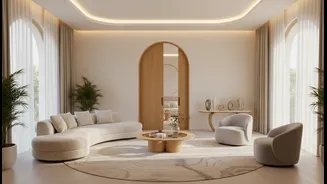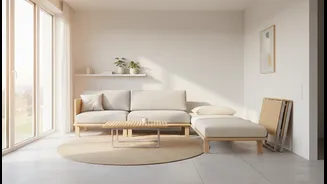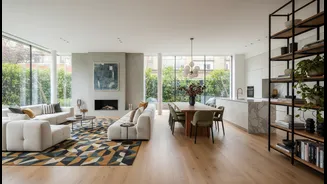






The Problem: That Awkward Crescent-Shaped Gap
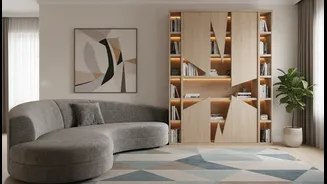
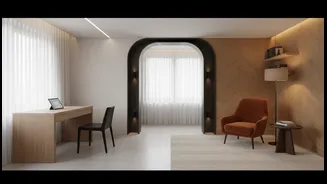
The main issue is simple geometry. Standard fitted storage—think bookcases, sideboards, and cabinets—is designed with straight lines and 90-degree angles. When you push this kind of furniture against a curved piece, you inevitably create an awkward, crescent-shaped
gap. This space is often too narrow to be truly useful but too large to ignore, becoming a dust trap and a visual disruption. It breaks the flow of the room and makes the layout feel unresolved, preventing the storage unit from feeling integrated with the larger furniture piece it's supposed to complement.
Solution 1: Go Custom for a Perfect Fit
The most seamless solution is to commission custom-built storage. A skilled carpenter can create a shelving unit, cabinet, or console table with a concave or convex front that perfectly hugs the curve of your bed or sofa. This eliminates wasted space and creates a high-end, bespoke look that makes the two pieces feel like a single, intentional design. While it's the most expensive option, the result is unparalleled in both function and form. For a more accessible version of this, look for modular storage systems that offer curved corner pieces, which can sometimes be adapted to fit.
Solution 2: Lean Into the Gap with a Slim Console
Instead of fighting the gap, use it. A very thin console table, often called a sofa table, can be slotted behind the furniture. The table's surface should ideally sit at or just below the height of the sofa or bed frame. This gives you a new, useful surface for a pair of lamps, decorative objects, or a place to set down a drink. The space underneath the table, though awkwardly shaped, is now perfect for sliding in low, shallow baskets for storing blankets, magazines, or remote controls. This approach turns a problem area into a functional and decorative zone.
Solution 3: Think Vertically with Floating Shelves
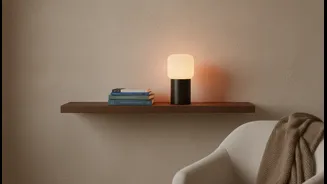
If the floor plan is the problem, look to the walls. Installing floating shelves above the curved section of the furniture bypasses the issue altogether. You can mount several shelves in a traditional stacked arrangement or get more creative with an asymmetrical layout. This provides ample storage for books and display space for art without consuming any floor space. For an even more integrated look, consider custom curved floating shelves that echo the shape of the furniture below, creating a beautiful sense of visual harmony and flow.
Solution 4: Fill the Space with Life and Light
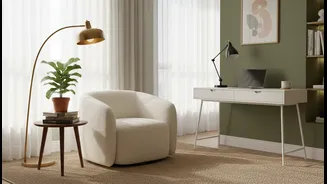
Sometimes, the best solution isn't more storage. Treat the awkward corner behind your curved sofa as a pocket of opportunity for a decorative feature. A tall, slender floor lamp can arc gracefully over the sofa, providing reading light while its base tucks neatly into the gap. This is also the perfect spot for a large potted plant, like a Fiddle Leaf Fig or a Kentia Palm. The plant's organic shape will soften the corner and complement the curves of the furniture, adding life, texture, and a sculptural element to the room.
Solution 5: Redefine the Area with a Rug
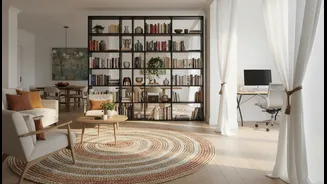
Use a rug to visually unite the furniture and the storage. Placing a large rectangular rug under both the curved sofa and a nearby straight-edged bookcase can ground the arrangement and make the layout feel more deliberate. Alternatively, an oval or round rug can reinforce the geometry of the curved piece, creating a distinct zone. The rug defines the boundaries of the seating area, and the storage unit can then be placed just off the edge of the rug, making the distance between the two pieces feel intentional rather than accidental.