




The Galaxy's Sleeping Heart
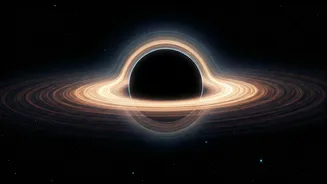
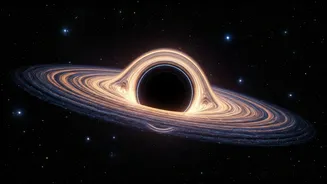
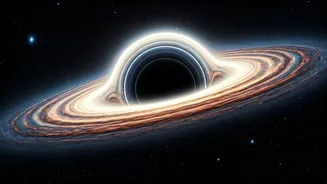
A supermassive black hole (SMBH) is an object of almost unimaginable density, with a mass millions or even billions of times that of our sun. Despite their reputation as cosmic vacuum cleaners, most are actually inactive. They are 'sleeping' because there
is no nearby material for them to feed on. In a stable, mature galaxy like our own, stars and gas clouds orbit the central black hole at a safe distance, leaving it in a quiet state. For a black hole to be active, it needs a steady supply of fuel. Without this fuel, it is effectively invisible, its gravitational influence felt but not seen.
A Cosmic Wake-Up Call
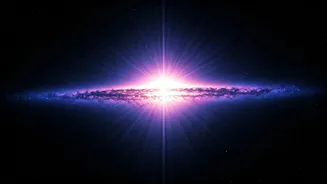
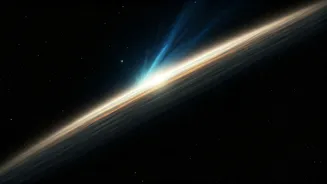
So, what can disturb this slumber? The most dramatic cause is a galaxy merger. When two galaxies collide, the gravitational chaos can send vast streams of gas and dust hurtling toward the central black hole. This sudden influx of matter provides the feast needed to awaken the giant. Another trigger can be a close encounter with a large star or a massive gas cloud that strays too near. The black hole's immense gravity rips the unfortunate object apart in what’s known as a tidal disruption event, pulling the resulting debris into a swirling, superheated disc. This process transforms the dormant black hole into a brilliant, energetic core known as an Active Galactic Nucleus, or AGN.
An Engine of Awesome Power
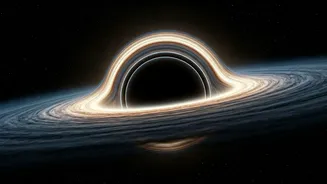
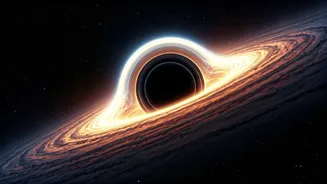
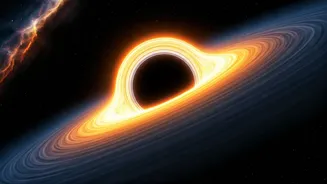
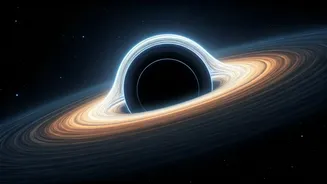
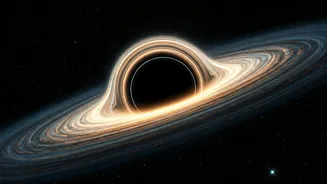
Once awakened, an AGN becomes one of the most powerful engines in the universe. The material spiraling inward forms an 'accretion disk'—a vast, spinning platter of gas and dust heated to millions of degrees by friction and gravitational forces. This disk can glow so brightly that it outshines all the hundreds of billions of stars in its host galaxy combined. But the light is only part of the story. The intense magnetic fields around the spinning black hole can capture charged particles and launch them outward in colossal jets that travel at nearly the speed of light, stretching for thousands, or even millions, of light-years into space.
A Tale of Creation and Destruction
This incredible output of energy, known as 'AGN feedback', has a profound and complex impact on the entire galaxy. On one hand, it can act as an agent of destruction for star formation. The powerful radiation and winds from the AGN can heat up or completely blow away the cold molecular gas required to form new stars. This process, called 'quenching', can effectively sterilize a galaxy, stopping its ability to create new stellar nurseries. However, the story isn’t so simple. There is also evidence for 'positive feedback'. The same powerful jets that clear gas from the galactic center can compress interstellar gas clouds further out, triggering intense bursts of star formation in those regions.
The Ultimate Galactic Sculptor
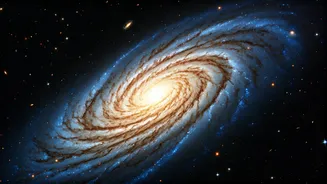
This dual role means waking black holes are not just residents of their galaxies; they are the chief architects of their evolution. The feedback process is a key reason why we see different types of galaxies in the universe. A galaxy with a highly active central black hole might have its star formation quenched early, evolving into a large, reddish galaxy filled with old stars, often called a 'red and dead' elliptical. In contrast, a galaxy with a quieter black hole might continue forming new, blue stars in its spiral arms for billions of years. By studying these active black holes, astronomers are piecing together how galaxies, including our own, were built and what their ultimate fate might be. Recent discoveries using gravitational waves have even offered a glimpse into the mergers that trigger these events, confirming their central role in the cosmic story.