




A Panoramic Camera for the Cosmos
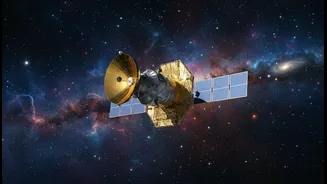
The most important thing to understand about the Roman Space Telescope is that it’s not a replacement for the Hubble or James Webb Space Telescopes (JWST). Instead, it’s a powerful new tool with a completely different specialty. Think of Hubble and Webb as
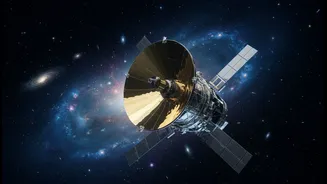
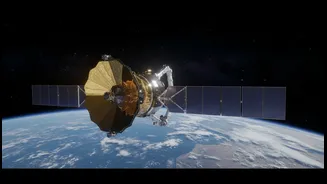
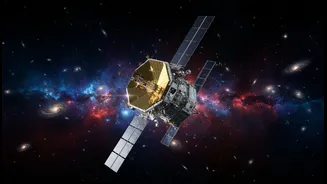
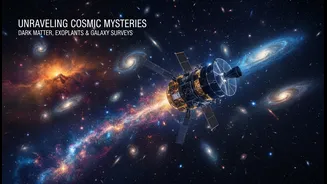
microscopes, designed to zoom in with incredible detail on specific, tiny patches of sky. Roman, on the other hand, is like a panoramic camera. While its primary mirror is the same size as Hubble's, its Wide Field Instrument will provide a field of view 100 times larger. This means it can map huge swathes of the universe with the same high resolution, surveying the sky thousands of times faster than Hubble ever could. In fact, what would take Hubble a century to observe, Roman could capture in about a month. This makes it a survey telescope, built to conduct a massive cosmic census.
Tackling the Universe's Biggest Mysteries
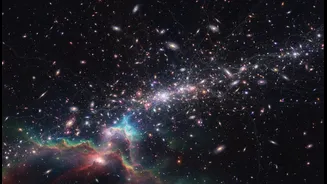
Roman’s primary mission is built around two key objectives that take full advantage of its wide-angle vision. First, it will tackle the profound mysteries of dark energy and dark matter. Dark energy is the unknown force causing the universe's expansion to accelerate, and dark matter is the invisible substance that provides most of the universe's gravitational scaffolding. By surveying over a billion galaxies and observing thousands of stellar explosions called supernovae, Roman will create vast 3D maps of the cosmos. These maps will allow scientists to measure how the universe has expanded over time and how dark matter has shaped the formation of galaxies, providing crucial clues about the nature of these enigmatic phenomena.
A New Era of Planet Hunting
The second major goal is to discover thousands of new exoplanets, or planets outside our solar system. While NASA's Kepler and TESS missions found planets by watching for the slight dimming of a star as a planet passes in front of it (the transit method), Roman will primarily use a different technique called gravitational microlensing. This method detects planets by observing how their gravity, combined with their host star's, bends and magnifies the light of a more distant star that happens to align perfectly behind them. This technique is sensitive to planets of various sizes, including those far from their star and even rogue planets that wander through the galaxy without a star to orbit. The mission is expected to find thousands of new worlds, dramatically expanding our census of planetary systems.
Testing Tech for the Future
Beyond its main survey work, Roman is also a testbed for groundbreaking new technology. It carries an instrument called a Coronagraph, which is designed to demonstrate that it's possible to directly image exoplanets by blocking the overwhelming glare of their host stars. This is incredibly difficult—like trying to photograph a firefly next to a searchlight. The Roman Coronagraph is an active system with self-flexing mirrors that can correct for tiny imperfections and disturbances, aiming to perform 100 to 1,000 times better than previous space coronagraphs. While its main goal is technology demonstration, it will directly image Jupiter-like planets and pave the way for future missions, like the proposed Habitable Worlds Observatory, which will seek to take pictures of Earth-like planets.
A Legacy of Vision
The telescope is named after Nancy Grace Roman, NASA’s first chief of astronomy and the first woman to hold an executive position at the agency. Known as the “Mother of Hubble” for her instrumental role in making that telescope a reality, Roman was a tireless advocate for space-based astronomy. Despite facing constant discouragement as a woman in a male-dominated field, she persevered, fundamentally shaping NASA’s science programs. The telescope itself has a unique heritage; its 2.4-meter mirror was originally built for a different purpose and was donated to NASA by the National Reconnaissance Office. It will launch on a SpaceX Falcon Heavy rocket from Kennedy Space Center, having arrived in Florida in late June 2026 for final preparations.