





The Old Town’s Storybook Charm
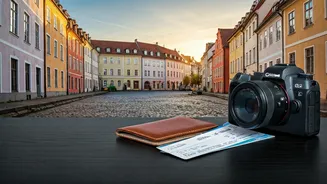
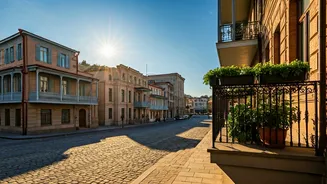
Your architectural journey begins in the heart of the city, the Old Town (Dzveli Tbilisi). This isn't one single style, but a beautiful, chaotic fusion of influences. Here, narrow, winding streets open into courtyards filled with the city's iconic carved
wooden balconies. These intricate structures, painted in vibrant colours, cling to buildings that show a mix of Georgian, Persian, and Ottoman design. Look for the domed sulphur baths in the Abanotubani district, with their distinctive brickwork reminiscent of Persian bathhouses. It feels less like a planned city and more like a living museum, where every corner reveals another layer of history. The best way to experience it is to simply get lost and let the architecture guide you.
Grandeur on Rustaveli Avenue
For a taste of imperial grandeur, take a stroll down Rustaveli Avenue. This is Tbilisi’s main artery, lined with magnificent 19th and early 20th-century buildings. Constructed during the Russian Empire's reign, these structures showcase Neoclassical and Beaux-Arts styles, giving the street a feel reminiscent of Paris or Vienna. Key highlights include the stunning Tbilisi Opera and Ballet Theatre, with its ornate Moorish-revival facade, and the former Parliament of Georgia building. These grand edifices were designed to project power and sophistication, and they stand today as monuments to a pivotal era in the city’s past. It’s a striking contrast to the intimate scale of the Old Town.
Discovering Art Nouveau Masterpieces
Hidden away in neighbourhoods like Sololaki and Chugureti are some of Tbilisi’s best-kept secrets: its Art Nouveau buildings. Known locally as the Secession style, these early 20th-century structures feature the flowing lines, floral motifs, and dramatic faces characteristic of the movement across Europe. Many of these buildings have faded facades, but their elaborate entryways and staircases remain breathtakingly beautiful. One of the most famous examples is at 3a Kojori Street, often called the “House of Kalantarov,” with a stunning painted entrance hall. Exploring these areas feels like a treasure hunt, rewarding the curious traveller with unique architectural finds that you won't see in standard guidebooks.
The Legacy of Soviet Modernism
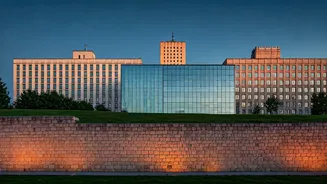
Tbilisi's Soviet period left an indelible, if controversial, mark on its skyline. For fans of Brutalism and Soviet Modernism, the city is a playground. These buildings are bold, ambitious, and often utterly strange. The most famous example is the former Bank of Georgia headquarters, a fascinating structure of interlocking concrete blocks that looks like it was built with giant Lego bricks. Another must-see is the Chronicles of Georgia, a massive, hilltop monument of colossal pillars depicting scenes from Georgian history and the Bible. While not universally loved, these structures are a powerful reminder of a complex past and offer a dramatically different architectural aesthetic.
Tbilisi’s Futuristic Vision
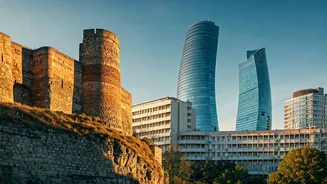
In the post-Soviet era, Tbilisi has embraced bold, contemporary architecture to signal its forward-looking identity. The most prominent examples are impossible to miss. The Bridge of Peace, an undulating glass-and-steel pedestrian bridge over the Mtkvari River, glows with thousands of LEDs at night. Nearby, the Rike Park Concert Hall and Exhibition Centre consists of two futuristic, metallic tubes that have earned it the nickname “the pipes.” These structures, designed by Italian architects, create a stunning juxtaposition with the historic buildings surrounding them. They represent a new, confident Georgia, unafraid to blend its ancient heritage with a cutting-edge vision for the future.